Friday, May 29, 2026

USA | Allegheny Mountains | Fawn Season


Fawns are making an appearance:


Thursday, May 14, 2026

USA | Allegheny Mountains | Canada Geese

 Every morning between eight and ten o’clock a pair of Canada Geese fly south past my Retreat. Usually they fly quite low, no more than twenty feet off the ground. They are always honking, living up to their nickname of Canadian Honkers. I assume they are coming from the swamps along a creek a mile north of my retreat, a favorite breeding ground of waterfowl and a well-known haunt of hunters. I have seen what I assume is the same pair of geese grazing in fields south of my retreat. In the evening they fly north, using exactly the same flight path they used in the morning. I assume they spend the night in the above-mentioned swamps. 
The pair of love-birds that fly by my Retreat everyday

Not sure if this is the goose or the gander
This pair of geese has probably not hooked up for overnight flings. Canada geese are genuinely monogamous and pair for life in the vast majority of cases—although there are a few exceptions. Most Canada geese select a mate at age 2–3 through what biologist call “assortative mating”, tending to choose partners of similar size. Once paired, the bond is maintained year-round—not just during breeding season—which is unusual among waterfowl. Pairs that have been separated even briefly greet each other with elaborate displays upon reunion. Given that Canada geese can live 10–25 years in the wild (and reportedly up to 30-plus years), a pair can easily remain together for a decade or more. The bond is notably deep: one mate will stay beside an injured or dying partner even as the rest of the flock moves on. Surviving geese have been observed to mourn for extended periods after a mate's death.

There are exceptions. Failure to reproduce can trigger what researchers call "divorce“—pairs that fail to produce young may separate and seek new mates. If a mate for any reason dies, or is killed by hunters, the survivor typically does find a new partner—usually within the same breeding season, though some older birds that have been together many years may remain alone for a prolonged period or permanently. Also, a goose that lost a previous mate and paired as a "substitute" bond (rather than an original pairing) is more likely to be unfaithful—an observation documented by ethologist Konrad Lorenz, who recorded only three pair dissolutions in years of observation, and two involved the same gander who had lost his first mate. Males!

In short, Canada geese are among the most faithfully pair-bonded birds in North America. The bond is genuinely lifelong under normal circumstances—but "until death do they part" is more accurate, since widowed geese do generally re-pair rather than stay single forever. I can only wish a long and happy life to the pair I see pass by my retreat every day.

Sunday, May 10, 2026

USA | Allegheny Mountains | Ramps

Traditionally Ramps season was said to peak on Mother’s Day, which is today. Due to our Changing Climate, however, they seem to have peaked about ten days ago.

Ramps

Ramps

Ramps at their peak

Ramp bulbs

Ramp leaves

The appearance of the flower stem is usually a sign that the plant is near the end of its edible stage.

Spaghetti and Ramps. 
Steamed (not boiled!!!) Ramps.

Croatia | Istrian Peninsula | Pula

From Venice I wandered on down to Pula in Croatia.

Old Roman-era portal leading to the old town of Pula (click on photos for enlargements)

Statue of James Joyce outside a cafe he frequented when he lived in Pula

Square in the old town of Pula, which is a pedestrians-only area. It was early morning so there was no one about.

 
Temple of Augustus, built by Emperor Augustus (r. 27 BC–AD 14), said to be the oldest Roman monument in Croatia. On the right is a Neo-Pagan tree offering; a Christmas tree, in other words.

The most famous Roman monument in Pula is the Amphitheater built in the first century a.d. by Roman Emperor Vespasian (r. 69–79). The amphitheater seated about 20,000. Gladiators fought each other here (whether they fought to the finish is unclear), and also fought wild beasts like lions and tigers, whose cages can still be seen. Nowadays we have only the NFL. But James Harrison would have made a great gladiator!


By the fifth century the teachings of the Nazarene, a temple to whom can be seen in the background, had replaced the pagan beliefs of the Romans and gladiatorial bouts were outlawed. Nowadays the amphitheater hosts concerts, film festivals, and other cultural events. The Foo Fighters, Luciano Pavarotti, Plácido Domingo, Norah Jones, Alanis Morissette, Sinéad O'Connor, Elton John, Sting, Michael Bolton, Seal, Tom Jones,  Leonard Cohen, and Grace Jones, among others, have all performed here.

Turkmenistan | Ashgabat | History Museum

My initial interest in Turkmenistan was spurred by my researches into the Mongolian Invasion Of Khwarezm, the ancient realm straddling the lower Amu Darya River and its delta where it flows into the Aral Sea, in the winter of 1220-21. The territory of old Khwarezm is today encompassed by both Uzbekistan and Turkmenistan. I had earlier visited Khiva, Janpiq Qala (fortress), and Gyaur Qala in the part of Khwarezm now in Uzbekistan, all sites attacked by Chingis Khan’s sons Ögedei and Chagatai as the Mongols swept through the region. The old Khwarezm capital of Gurganj is in Turkmenistan, however, eight and a half miles from the border and thirteen miles from Gyaur Qala. The ruins of Gurganj are close to the city of Konye (old) Urgench, not to be confused with the new city of Urgench in Uzbekistan. I of course wanted to visit Gurganj, which had put up the fiercest resistance of any city the Mongols had up to that point in time encountered in Islamic Inner Asia, but since I had no Turkmenistan visa and only a single entry Uzbek visa I was unable to cross the border.

Immediately upon my return from Uzbekistan I launched plans to enter Turkmenistan via its capital of Ashgabat and travel north to Konye Urgench. I soon learned that travel by foreigners in Turkmenistan was not a stroll in the park. A visa could only be obtained after a government-approved tourist agency had obtained a Letter of Invitation from the Turkmenistan authorities and most if not all travel agencies will not get you the Letter of Invitation unless you arranged your entire trip, including transportation and accommodations, through them. So it appeared pretty much impossible just to wander about on your own.  I contacted a travel agency in Ashgabat and told them that I wanted to visit Konye Urgench plus a number of other historical sites, some of them directly connected with the Mongol invasion and others not, which had turned up in my various researches. They very quickly responded with a detailed fourteen-day itinerary including most of the places I had mentioned and a few which they thought might be of interest to someone like myself who appeared to have an historical turn of mind. I had not heard of some of these places, but since they appeared to be on the route to the places I was interested in I thought I might as well check them out also. Since it would be difficult if not impossible to visit all these place in fourteen days using Turkmenistan’s dicy public transportation system they suggested that I charter a vehicle for the entire fourteen day trip. The travel agency’s drivers, I was told, did not speak English, but since my driver would simply be taking me on the approved itinerary, with pre-arranged stops each night, they did not anticipate any problems.

Actually this plan appealed to me. I had used drivers in Uzbekistan who did not speak English and had managed to communicate with them using my very basic Russian. I expected that my driver would also speak some Russian, since Turkmenistan like Uzbekistan was once part of the Soviet Union and Russian was widely taught in its schools and still used by many segments of the population. If the driver did speak Russian we could deal with simple logistical matters when necessary but the rest of the time I could just sit back and indulge in my own historically inspired revelries and daydreams without the tiresome personal interactions required by the presence of a guide or translator. In short, I would be pretty much on my own, except for the driver who would also be acting as my government-approved escort. 

I emailed a copy of my passport, photos, and personal information to the travel agency and two weeks later received the much-coveted Letter of Invitation. I was to present this to immigration officials at the Ashgabat airport and receive my visa there. Since I was in Ulaanbaatar, Mongolia at the time, I flew from there on the direct flight to Istanbul (there is a one hour stop  in Bishkek, Kyrgyzstan, but you do not have to change planes). Surprisingly enough—at least to me—Turkish Airlines has two flights a day seven days a week to Ashgabat. After three days in Istanbul examining the recent acquisitions of my favorite Carpet Dealers and checking the  prices of spices in the shops lining the alleys just west of the Egyptian Bazaar (the best quality Iranian saffron is now selling for $925 a ounce), I took the metro to the airport for my 1:00 a.m. flight to Ashgabat. I would make my purchases on the return leg of the trip. 

When I arrived at the airport at 11:00 p.m. I was a bit disconcerted to find lined up at the business check-in counter forty or fifty people, mainly women, all with carts piled high with monumental mountains of baggage. My God, were all these people flying business class? It turns out not. They were small-time traders from Turkmenistan who had flown to Istanbul to buy goods for resale in Ashgabat. Since the business class check-in area was not much in use at this time of the night they had been herded here to get their heaps of luggage checked in.  I and some Chinese men flying business was shown to the front of the line and quickly checked in. The three-hour, 1570-mile flight from Istanbul to Ashgabat left at 1:15 a.m. It was sold out. Eight seats in the sixteen-seat business section were occupied by Chinese businessmen attending some energy-related conference. 

After about two hours we passed over the middle of the the Caspian Sea,  250 miles wide at this point, its inky black surface dotted with brightly lit offshore drilling platforms and gas flares. After another half hour we began our descent through heavy cloud cover to Ashgabat. It was raining hard when we finally touched down at 6:20 a.m. local time. Given all the rigamarole involved in getting an letter of invitation to the country, the procedure at the airport was quite easy. I presented my letter of invitation and was very quickly given a visa. There were no entry or customs documents to fill out and my luggage was x-rayed but not opened.  One of the women operating the x-ray machine said in English, “Have a nice stay in Turkmenistan.”

In the reception area I was met a young man from the tourist agency who whisked me away to my hotel. I had been told earlier that my room would not be available until noon. The plan was to stash my luggage at the hotel, have breakfast, then take a tour of the city in the morning until my room was free. I have very little if any interest in history which postdates the fall of the Ottoman Empire, and since Ashgabat is a fairly new city founded in the 1880s by Russian colonialists I doubted that there was much I would want to see.  The alternative, however, was to sit in the hotel lobby until my room was available. 

My driver, a young man in his twenties, spoke no English but as I had expected he spoke Russian. The rain was coming down even harder as we cruised down the wide multi-lane streets, mostly deserted at this hour of the morning. A bewildering array of huge white buildings reared up out of the rain and fog: the immense gold-domed Presidential Palace fronted with cascades of water; the likewise enormous many-columned Turkmen Parliament building; a vast Exhibition Center set in immaculately landscaped park complete with pools and fountains; the Academy of Sciences Building; the Carpet Museum, which according to my driver contains the largest handmade carpet in the world, duly recognized in the Guinness Book of World Records; a  children’s park containing what at first glance appeared to be a gigantic white candy life-safer but is actually the world’s largest ferris wheel (also in the Guinness Book of World Records); blocks of twelve-or-more-story luxury apartment buildings which seemed to stretch off into infinity; and much, much else. All the buildings seemed oversized, and all were white. The whole effect was almost hallucinatory. I had come to visit thirteen-century historical sites but seemed to have dropped into some futuristic city designed by a Turkic reincarnation of Albert Speer on acid. That I been up for over thirty hours and had guzzled a least half a gallon of coffee in the business lounge in Istanbul, on the plane, and at breakfast in my hotel certainly didn’t help my mental state. 

Having seen enough of Ashgabat for the moment I asked the driver to take me to the National History Museum, which I had heard contained an outstanding collection of 2000 year-old rhytons  and ostrakons from the ruins of the old Parthian capital city of Nisa located about ten miles west of Ashgabat. In front of the museum is a 436-foot flagpole which my driver claims is the tallest in the world; actually it’s the fourth tallest, after flagpoles in North Korea, Azerbaijan, and Tajikistan. 
Fourth tallest flagpole in the world (click on photos for enlargements)
National History Museum
I run through the still pouring rain and take refuge in the museum, which is very new, very elegantly appointed, and very quiet. I am the only visitor. I cannot help but notice that the floors, staircases, and immense pillars which hold up the central dome are all made of exactly the same kind of stone which I used for the countertops in the kitchen of my hovel in Mongolia. Someone here has good taste. 
Interior of the Museum. Love that stone!
The next thing to catch my eye is an immense carpet covering a large part of the back wall of the building. This is not largest handmade carpet in the world—that honor apparently goes to the specimen in the Carpet Museum—but this one comes close. It was made to celebrate the fifth anniversary of Turkmenistan’s independence following the fall of the Soviet Union. Thirty-eight carpet weavers worked from April 6, 1996 to October 10, 1996 to complete  the 43-foot by 68-foot carpet. It’s a beaut, no doubt. 
43-foot by 68-foot hand-made carpet
The main exhibitions showcasing findings from Nisa, Gonur Tepe, and Merv—all places on my itinerary—are on the second floor. I spend an enjoyable three hours poring over these artifacts and when I next look out the window the clouds have cleared and the sun is shining. It’s time to visit Nisa.

Saturday, May 9, 2026

USA | Allegheny Mountains | Great Allegheny Passage Bike Trail (GAP) | Flora | Yellow Violets

At least five yellow violets occur along the GAP. The three most common are the Early Yellow Voilet (Viola rotundifolia), the Spear-leaf Violet (Viola hastata), and the Downy-yellow Violet (Viola pubescens). First of all, why are there yellow violets? Shouldn't violets be violet or at least blue, like the Common Blue Violet found along the GAP? Actually the word violet names a lineage, not a color. All true violets belong to the genus Viola, a worldwide group of roughly 525 to 600 species. The famous Swedish biologist Carolus Linnaeus (1707–1778) first named the purple-flowered species of Europe, but the genus Voila turned out to be far larger than its namesake: as botanists catalogued relatives across the Americas and Asia they kept finding plants with the same floral architecture — five petals and a spurred lower lip, in colors of white, cream, multicolor, and yellow. The genus name stuck; the color palette diversified. Yellow, in particular, is not an accident. It reads well in the dim light of a deciduous understory, where early-spring pollinators—small mining bees, bee flies, the occasional mason bee—are doing most of the work. The dark purple lines on the lower petal of yellow violets are nectar guides, painted to steer those visitors in. On the GAP, this is why Viola hastata, V. rotundifolia, and V. pubescens, are fully legitimate violets despite their yellow petals. Same family tree, same fritillary host role, same spring woodland habit—just wearing the understory’s preferred color.


Early Yellow Voilet. 04.04.26

Early Yellow Voilet. 04.04.26

Early Yellow Voilet. 04.04.26

Early Yellow Voilet. 04.04.26

The Spear-leaf Violet has spearhead-shaped leaves. 04.13.26

 Spear-leaf Violet. 04.12.26

 Spear-leaf Violet. 04.14.26


 Spear-leaf Violet. The dark purple lines on the lower petal are nectar guides for the benefit of pollinators. 04.13.26

Downy-yellow Violet. 04.16.26

Downy-yellow Violet. 04.16.26

Italy | Venice | Palazzo Mocenigo

Wandered by the Museum of Palazzo Mocenigo, just behind the Church of San Stae on the Grand Canal. The museum also hosts the Study Centre of the History of Textiles, Costumes and Perfume. The museum and study center is housed in the former palazzo of the Mocenigos, one of the most prominent families in Venice for a period of several hundred years. Seven Mocenigos became doges: Tommaso (1414–23), Pietro (1474–76), Giovanni (1478–85), Alvise I (1570–77, Alvise II (1700-1709), Alvise III (1722-32), and Alvise IV (1763). There were two branches of family, one located here at San Stae and another further on down the Grand Canal at San Samuele. A member of the San Samuele branch, Giovanni Mocenigo, was notorious for denouncing irrepressibly hard-core pantheist and unapologetic Hermetic occultist Giordano Bruno to the Catholic Inquisition, which resulted in Bruno being burned at the stake in Paris on Ash Wednesday, February 17th, 1600.
Church of San Stae
Entrance to Palazzo Mocenigo
Costume Exhibit (click on photos for enlargements)
Costume Exhibit
Costume Exhibit

Costume Exhibit
Costume Exhibit
Book of perfume recipes plus raw ingredients for making Perfume. I was of course in Seventh Heaven here. 

Thursday, May 7, 2026

Türkiye | Tur Abdin | Mor Gabriel Monastery

After visiting Midyat we wandered down to Mor Gabriel Monastery, twelve miles southeast of Midyat and fifteen miles north of the Syrian border. Here, at least, Syriac Christianity appears to be surviving. This is one of the oldest monasteries in the world. It was founded in 397 by Mor (saint) Samuel (d. 433) and Mor Simon (d. 409). Originally it was called the Monastery of Mor Samuel and Mor Simon, but in the seventh century it was renamed Mor Gabriel Monastery after Mor Gabriel (634-668), the bishop of the Tur Abdin Region. Except for brief periods during wars and civil disorders the monastery has operated continuously since the year 397. Visitors are not allowed to wander around the grounds by themselves (although you can stay overnight if you make previous arrangements), but a guide is provided to give you a tour. Our guide, a young Syriac Christian, spoke perfect, unaccented English. 

Entrance to the monastery (click on photos for enlargements)

Entrance to the courtyard

Inner courtyard of the monastery

Monastery grounds

Steeples

This circular room, a later addition to the original monastery, was built in the sixth century with funds provided by the notorious Empress Theodora, the wife of Byzantine Emperor Justinian I

Circular Room. The small windows on the dome open on monks’ cells. 

Our guide related that Theodora was born near here, in what is now Syria, and that her father was a Syriac priest. It was this connection with the area and the Syriac Church that motivated her to make a sizable donation to the monastery for the purpose of building this room. This is the sanitized version of Theodora’s background. Most sources do agree that she was born in Syria, but many maintain that Theodora was the daughter of a bear trainer and a professional dancer and actress. They began pimping out Theodora and her sister Komito when they were both pre-adolescents. Theodora quickly began one of Constantinople’s most notorious prostitutes. If we are to believe the Byzantine historian Procopius (c. AD 500 – c. AD 565), who probably knew her personally, Theodora engaged in behaviour which would make even Kim Kardashian blush.

None of this mattered to Emperor Justinian, who became besotted with Theodora and eventually married her. As the wife of a Byzantine emperor Theodora might well have wanted to upgrade her image by donating money to religious institutions. Thus she has been memorialized here at Mor Gabriel Monastery. Justinian himself initiated the construction of Aya Sofia in Istanbul, to this day one of the most magnificent religious structures in the world. Maybe he was feeling guilty about marrying a nymphomaniacal prostitute and wanted to do something to atone for it?

Theodora (c. 500 – 28 June 548) portrayed on a mosaic in a church in Ravenna, Italy (not my photo)

This was probably the dining hall in the monastery

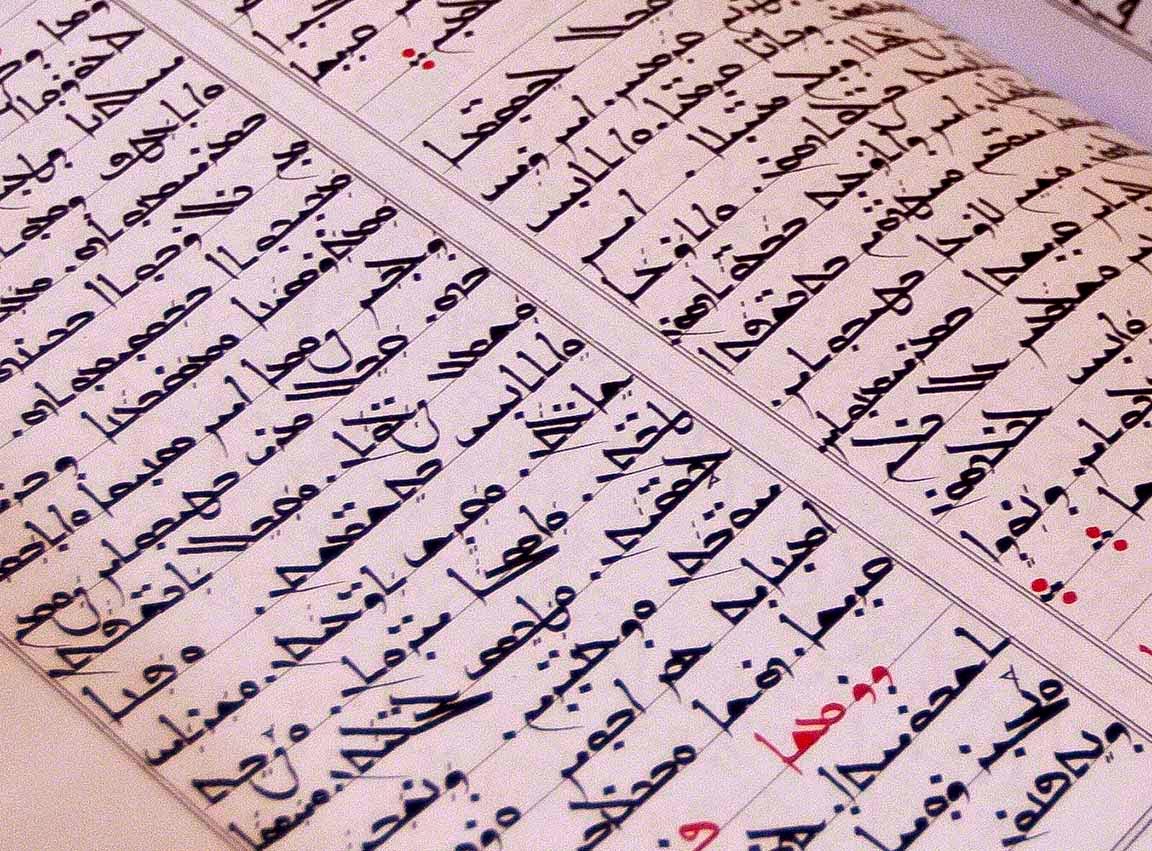
A book, I believe a Bible, but I am not sure, in Syriac Script. The Syriac Language is closely related to Aramaic, the language spoken by Jesus of Nazareth, leader of the Galileans.

The Syriac Script was based on the ancient Aramaic Script. The Sogdians of Inner Asia adapted the Syriac Script into their own Sogdian Script; the Uighurs in what is now Xinjiang Province in China adapted the Sogdian Script into their own Uighur Script; and later the Uighur Script was used as the basis for the Traditional Mongolian Script. Thus the Mongolian Vertical Script, which is experiencing somewhat of a revival in Mongolia, can be traced back to the ancient Aramaic Script, a variation of which is still used by Syriac Christians in Turkey today. 
Closer view of Syriac Script. 
A Syriac inscription on a wall in the monastery

New addition to the monastery. Local stone carvers and masons have lost none of their traditional skills.
Good example of local stonework