After visiting Midyat we wandered down to Mor Gabriel Monastery, twelve miles southeast of Midyat and fifteen miles north of the Syrian border. Here, at least, Syriac Christianity appears to be surviving. This is one of the oldest monasteries in the world. It was founded in 397 by Mor (saint) Samuel (d. 433) and Mor Simon (d. 409). Originally it was called the Monastery of Mor Samuel and Mor Simon, but in the seventh century it was renamed Mor Gabriel Monastery after Mor Gabriel (634-668), the bishop of the Tur Abdin Region. Except for brief periods during wars and civil disorders the monastery has operated continuously since the year 397. Visitors are not allowed to wander around the grounds by themselves (although you can stay overnight if you make previous arrangements), but a guide is provided to give you a tour. Our guide, a young Syriac Christian, spoke perfect, unaccented English.

Entrance to the monastery (click on photos for enlargements)

Entrance to the courtyard

Inner courtyard of the monastery

Monastery grounds

Steeples
This circular room, a later addition to the original monastery, was built in the sixth century with funds provided by the notorious Empress Theodora, the wife of Byzantine Emperor Justinian I.

Circular Room. The small windows on the dome open on monks’ cells.
Our guide related that Theodora was born near here, in what is now Syria, and that her father was a Syriac priest. It was this connection with the area and the Syriac Church that motivated her to make a sizable donation to the monastery for the purpose of building this room. This is the sanitized version of Theodora’s background. Most sources do agree that she was born in Syria, but many maintain that Theodora was the daughter of a bear trainer and a professional dancer and actress. They began pimping out Theodora and her sister Komito when they were both pre-adolescents. Theodora quickly began one of Constantinople’s most notorious prostitutes. If we are to believe the Byzantine historian Procopius (c. AD 500 – c. AD 565), who probably knew her personally, Theodora engaged in behaviour which would make even Kim Kardashian blush.
None of this mattered to Emperor Justinian, who became besotted with Theodora and eventually married her. As the wife of a Byzantine emperor Theodora might well have wanted to upgrade her image by donating money to religious institutions. Thus she has been memorialized here at Mor Gabriel Monastery. Justinian himself initiated the construction of Aya Sofia in Istanbul, to this day one of the most magnificent religious structures in the world. Maybe he was feeling guilty about marrying a nymphomaniacal prostitute and wanted to do something to atone for it?

Theodora (c. 500 – 28 June 548) portrayed on a mosaic in a church in Ravenna, Italy (not my photo)

This was probably the dining hall in the monastery

A book, I believe a Bible, but I am not sure, in Syriac Script. The Syriac Language is closely related to Aramaic, the language spoken by Jesus of Nazareth, leader of the Galileans.
The Syriac Script was based on the ancient Aramaic Script. The Sogdians of Inner Asia adapted the Syriac Script into their own Sogdian Script; the Uighurs in what is now Xinjiang Province in China adapted the Sogdian Script into their own Uighur Script; and later the Uighur Script was used as the basis for the Traditional Mongolian Script. Thus the Mongolian Vertical Script, which is experiencing somewhat of a revival in Mongolia, can be traced back to the ancient Aramaic Script, a variation of which is still used by Syriac Christians in Turkey today.
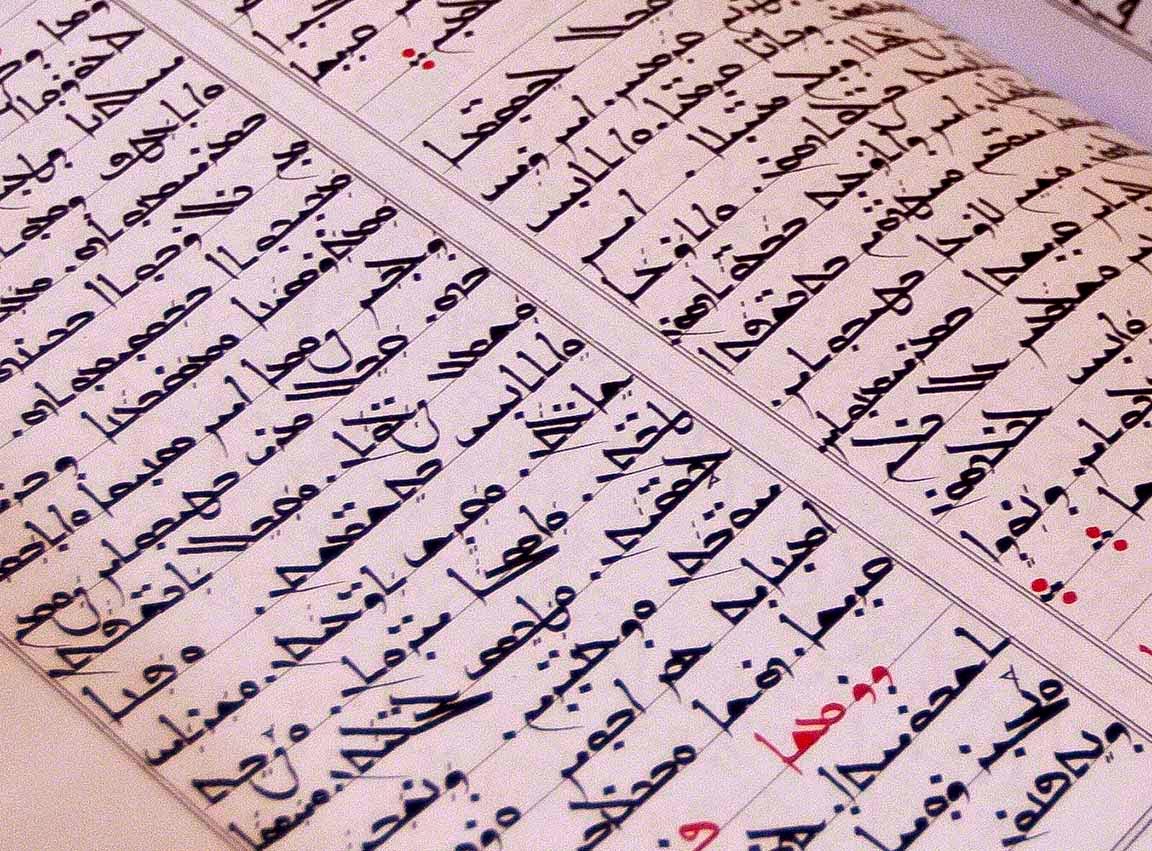
Closer view of Syriac Script.

A Syriac inscription on a wall in the monastery

New addition to the monastery. Local stone carvers and masons have lost none of their traditional skills.

Good example of local stonework

