Monday, January 25, 2021

Turkmenistan | Nohur | Kopet Dag Mountains

I was extremely eager to see the ruins of the city of Dehistan, 195 miles northwest of Ashgabat as the crow flies. The city was located on the old flood plain of the Amu Darya River back when the river flowed into the Caspian Sea and not the Aral Sea, as it now does. Dehistan was founded by the Khwarezmshahs who ruled the Khwarezmian Empire up until the early thirteenth century when Chingis Khan And His Boys invaded the region. The buildings and minarets found there, now in ruins, are probably the only examples of structures built under the direction of the last Khwarezmshah, Muhammad II. Now you can understand why I was so determined to visit the site. 

It is possible to drive to Dehistan directly from Ashgabat, the capital of Turkmenistan. The tourist agency from which I had hired a car and driver suggested, however, that I make a detour through the Kopet Dag Mountains and visit the small village of Nohur, where I would be able to spend the night with a local family. Although I was raring to go to Dehistan I thought that it might be interesting to get of glimpse of the Kopet Tag Mountains on the way and so agreed to the detour. 
The Kopet Dag Mountains rearing up along the southern border of Turkmenistan (click on photos for enlargements).
The Kopet Dag Mountains, which constitute the northern edge of the Iranian Plateau, run for some four hundred miles along the southern border of Turkmenistan. From Ashgabat we drove fifty-two miles west through the desert fronting the Kopet Dag to the town of Barharly and then turned southwest onto a gravel road which climbed into the mountains. Nohur is about twenty-four miles from Barhaly as the crow flies, at an attitude of 3100 feet, some 2650 feet above the desert immediately to the north. The Iranian border is just sixteen miles away to the south. 
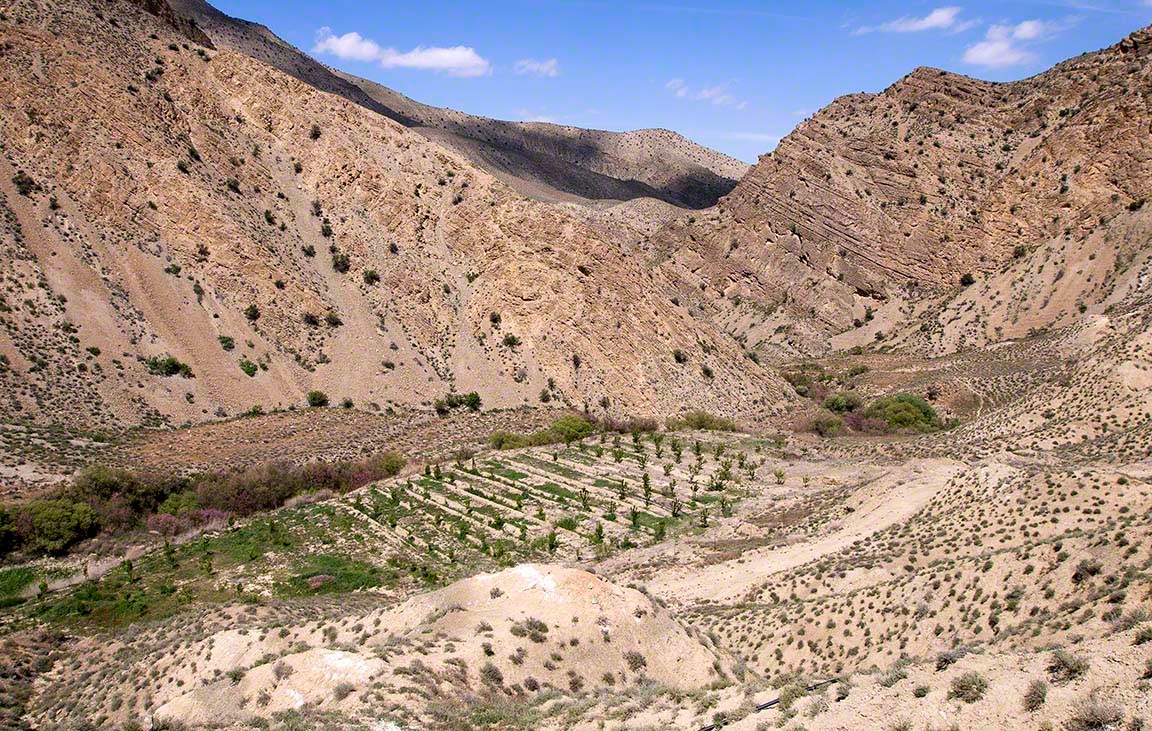
 Climbing into the Kopet Dag Mountains. An apricot orchard can see seen in the bottom of the valley. 
The village of Nohur is inhabited by an ethnic group known by the same name, the Nohurs. According to one legend, perhaps apocryphal, the Nohurs are descended from the soldiers of the Greek adventurer and gadabout Alexander the Great. Whatever their origins, they are decidedly different from the usual Turkmen and speak a dialect incomprehensible to outsiders. They maintain their ethnic purity by marrying only within the group. Although known for their strict adherence to Islam, elements of animism and Zoroastrianism can be detected in their religious practices. They are also famous for their work ethnic and members of the group who have established businesses in Ashgabat and other cites have achieved considerable wealth and power.

One of the most unusual features of the town of Nohur is the local cemetery. Almost all grave markers are topped by the horns of mountain sheep and ibex collected by local hunters.
 Nohur Cemetery
 Nohur Cemetery
 Nohur Cemetery
 Nohur Cemetery
 Nohur Cemetery
 Nohur Cemetery
 Nohur Cemetery
 Nohur Cemetery
 Nohur Cemetery
 Nohur Cemetery
 Nohur Cemetery
Nohur is also known for its silk weaving. The silk itself is imported from Iran and hand-woven using traditional local designs. 
 Silk Weaver. As can be seen, the woman has a scarf over her mouth. Nohur women traditionally wear a scarf over their mouths “so that they will not say silly things,” at least according to local lore. 
Silk Weaver
The house where I spent the night. The owners were a man and woman in their sixties. They had a daughter with a small baby who was the apple of everyone’s eye. The woman made a mean mutton plov. They also had wonderful local butter, honey, and cherry juice.
 Plateau west of Nohur
Plateau west of Nohur
Ramparts at the edge of the plateau
Village at the base of the ramparts. This village had wonderful honey for sale.
Two silk hangings I bought in Nohur, now in the Galleria of my hovel in Zaisan Tolgoi. The painting is by the father of Mongolian Artist Mönkhtsetseg.

Friday, January 1, 2021

Mongolia | Zaisan Tolgoi | Galleria | Soyolma

The Galleria of my Hovel in Zaisan Tolgoi. The center hanging is by artist Anunaran. (click on photos for enlargements)
Painting in my Galleria by artist Soyolma
Detail of painting in my Galleria by artist Soyolma
Painting of fierce female deity Narkhajid in my Galleria by artist Soyolma
Detail of painting of Narkhajid in my Galleria by artist Soyolma.
Painting of Narkhajid in my Galleria by artist Soyolma.
Detail of painting of Narkhajid in my Galleria by artist Soyolma. In her left hand is a cup made from a human skull. The cup is filled with blood. This is one lady you do not want to mess with.
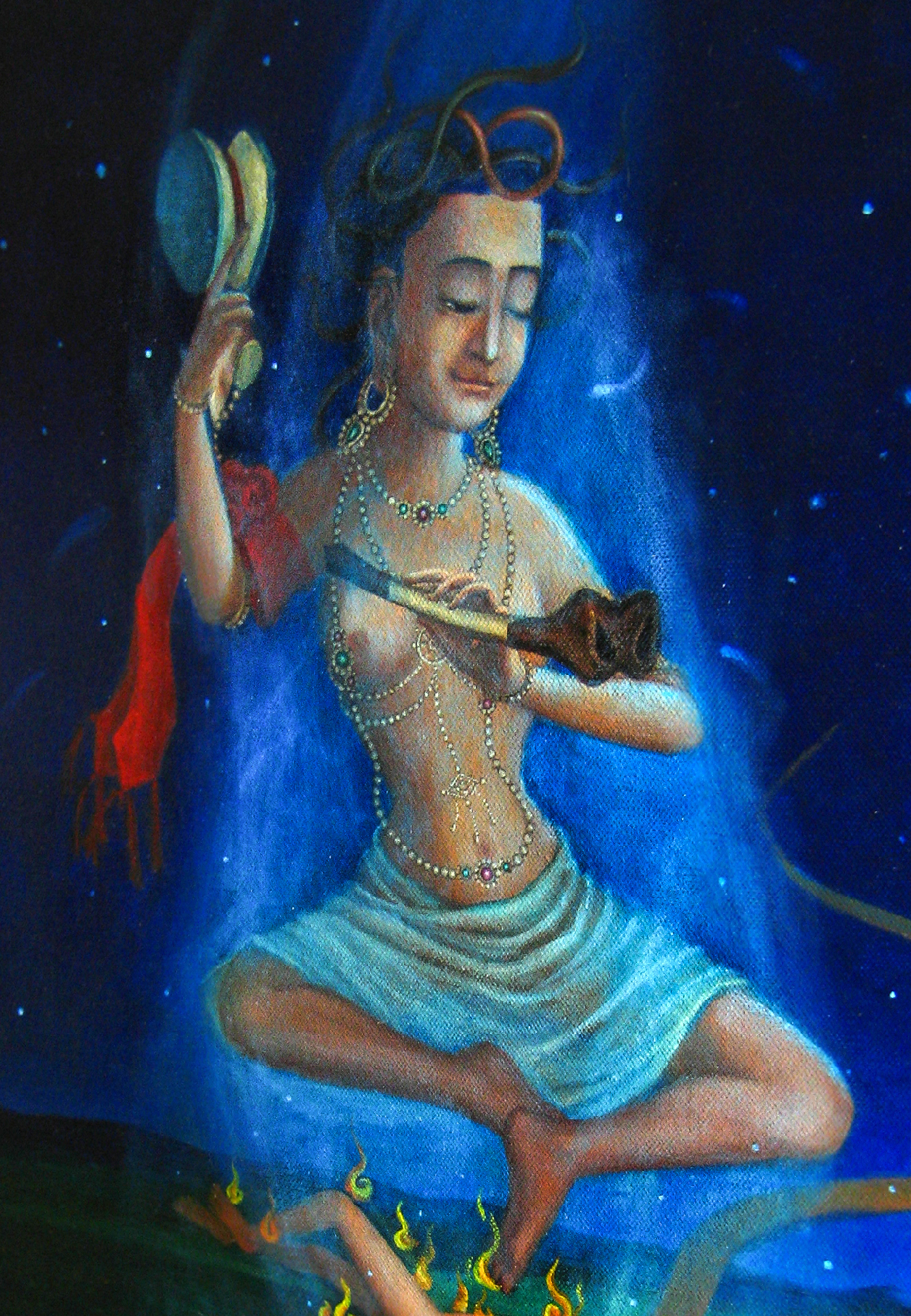
Tara-like painting by Soyolma, apparently a composite of White Tara and Green Tara. Like Green Tara she is bathykolpian, but is holding a lotus in her right hand like White Tara. White Tara also by tradition has a eye in the palm of her outstretched left hand. Here she is holding instead an enigmatic figure of a young woman. Also, White Tara is usually portrayed sitting in a full lotus position; Green Tara usually has one leg hanging down. The figure in this painting seems to be sitting in a rather loose half lotus position halfway between the postures of traditional White and Green Taras. Thus she would seem to be indicative of both. 
Painting by Soyolma
Painting by Soyolma. As can be seen in the two paintings above, small figures dwelling in trees are a staple of Soyolma’s work. 
Detail of painting by Soyolma
Painting by Soyolma
Soyolma also does traditional thangkas. This is her White Tara, also in my Galleria.

Mongolia | Zaisan Tolgoi | Galleria | Soyolma

The Galleria of my Hovel in Zaisan Tolgoi. The center hanging is by artist Anunaran. (click on photos for enlargements)
Painting in my Galleria by artist Soyolma
Detail of painting in my Galleria by artist Soyolma
Painting of fierce female deity Narkhajid in my Galleria by artist Soyolma
Detail of painting of Narkhajid in my Galleria by artist Soyolma.
Painting of Narkhajid in my Galleria by artist Soyolma.
Detail of painting of Narkhajid in my Galleria by artist Soyolma. In her left hand is a cup made from a human skull. The cup is filled with blood. This is one lady you do not want to mess with.
Tara-like painting by Soyolma, apparently a composite of White Tara and Green Tara. Like Green Tara she is bathykolpian, but is holding a lotus in her right hand like White Tara. White Tara also by tradition has a eye in the palm of her outstretched left hand. Here she is holding instead an enigmatic figure of a young woman. Also, White Tara is usually portrayed sitting in a full lotus position; Green Tara usually has one leg hanging down. The figure in this painting seems to be sitting in a rather loose half lotus position halfway between the postures of traditional White and Green Taras. Thus she would seem to be indicative of both. 
Painting by Soyolma
Painting by Soyolma. As can be seen in the two paintings above, small figures dwelling in trees are a staple of Soyolma’s work. 
Detail of painting by Soyolma
Painting by Soyolma
Soyolma also does traditional thangkas. This is her White Tara, also in my Galleria.

Wednesday, December 2, 2020

Tibet | Takten Damcho Ling | Taranatha


I posted previously on The Great Stupa of Jonang and Dölpopa. A couple of miles down the side valley in which the stupa is located, fronting on the main valley of the Tsangpo River, is the monastery of Takten Damcho Ling, founded by the famous historian and Kalachakra practitioner Taranatha, the previous incarnation of Zanabazar, the First Bogd Gegeen of Mongolia. 


The lower section of the Takten Damcho Ling complex, with the Tsangpo River in the distance


Another view of the lower part of the complex. 


Taranatha (1575–1634) was, at least within the Jonang tradition, thought be an incarnation of Kunga Drölchok, who like Dölpopa had been born in what is now Nepal. Also like Dôlpopa,  Kunga Drölchok was first a follower of the Sakya sect. He eventually received the Jonang transmission of the Kalachakra Tantra and other Jonang teachings. Later he was asked to head the Jonang sect. After he died, Taranatha become leader of the Jonangpa. In the words of Cyrus Stearns, author of The Buddha from Dölpo: A Study of the Life and Thought of the Tibetan Master Dölpopa Sherab Gyaltsen:


In the history of the Jonang tradition, Taranatha is second in importance to Dölpopa himself. He is responsible for the short-lived Jonang renaissance in Tsang and Central Tibet during the late sixteenth and the early seventeenth centuries, and the widespread revitalization of the shentong theory in particular. 


He was one of the last great translators of Sanskrit tantric texts into Tibetan and was an incredibly prolific writer himself. His History of Buddhism in India and The Origin of Tara Tantra are still in print today. 


Takten Damcho Ling was established by Taranatha in 1615 with funds provided by the Tsang ruler Desi Puntsok Nyamgyal (the monastery is also known as Puntsok Ling). When it was finally completed in 1628 it was the largest Jonang monastery in Tibet, boasting of a large college, sixteen temples, and a printing press. Some 10,000 monks were said to live in the monastery and the surrounding area. According to monks there today many of the temples were destroyed during the Cultural Revolution. Currently eight of the temples are in use. The monastery also has a small guesthouse where I stayed when I visited. There are no other tourist facilities in the area.


Lower part of Takten Damcho Ling looking up toward the upper ruins


Ruins of upper part of Takten Damcho Ling


Upper part of Takten Damcho Ling


Upper part of Takten Damcho Ling