It is my fourth day at the Popova Kula Winery, a Thursday, and I am still the only guest here. I checked on the internet and discovered, however, that this coming Saturday night the place is full-up with no rooms available. Luckily I am checking out Saturday morning. Incorrigible misanthrope that I am, I have been enjoying the solitude. Meanwhile I am continuing my investigations of the local vintages. The winery produces eleven different kinds of wine:
—Stanushina
—Vranec
—Prokupec
—Cabernet Sauvignon
—Merlot
—Sauvignon Blanc
—Temjanika,
—Chardonnay
—Zilavka
— Muscat Ottonel
—Muscat Hamburg
Stanushina, Prokupec, Vranec, Temjanika, and Zilavka are made from grapes indigenous to the Balkan Peninsula; these are the only varieties I am interested in. God forbid that I should come to Macedonia just to drink Cabernet Sauvignon or—horrors!— Merlot!
According to archeological findings, grapes has been grown and wine produced in the area of Demir Kapiya for at least the last 3600 years. The modern history of viniculture in the Demir Kapiya area began in 1927 when King Alexander Karadjordjevic of Yugoslavia (1888–1934) built a winery here to produce wine for the exclusive use of his royal family. Experts assured the king that of all possible locations in his kingdom, which covered a good part of the Balkan Peninsula, including modern-day Serbia, Croatia, Bosnia and Slovenia, this area was the most fertile and best suited for growing grapes and producing wine. He named the property the Winery of The Queen Maria in honor of his wife, Maria Karadjordjevic. The king hired the best vintners available and the winery was soon producing wine of extraordinary quality. Unfortunately King Alexander Karadjordjevic was unable to enjoy the fruits of his vineyards for long. On October 9, 1934, during a state visit to Marseille, France, he was assassinated by Bulgarian revolutionary Vlado Chernozemski.
 |
| King Alexander Karadjordjevic of Yugoslavia (click on photos for enlargements) |
The subsequent history of the winery is a bit hazy, but apparently it continued producing wine in the decades thereafter, except during the world wars and various local upheavals. After the Second World the Royal Winery, along with other wineries in what was then Yugoslavia, were nationalized. Over 30,000 families who owned small private vineyards continued, however, to supply grapes to these wine making facilities. It was these people who are credited with maintaining the high quality of local viniculture during the following decades. After the breakup of socialist Yugoslavia in the 1990s and the emergence of the former Yugoslavian republic of Macedonia as an independent country most if not all wineries were privatized. The royal winery in Demir Kapiya was privatized in 1994 and is now known as the Royal Winery Queen Maria. The current winery has an on-site restaurant and rents out rooms, apartments, and for high-rollers the former villa of Queen Maria Karadjordjevic.
 |
| King Alexander and Queen Maria |
 |
| Popova Kula Winery |
 |
| The “Priest’s Tower” of Popova Kula |
Curious about this Roman road, I went down to the lobby and questioned the receptionist, a charming woman in her thirties. She in turn questioned one the local workmen who happened to be handy, and this guy said the Roman road in question was the famous Via Egnatia dating to the time of the Roman Empire, which ran from Durrës in what is now Albania east 696 miles to Constantinople, right across the heart of the Balkan Peninsula. This was certainly intriguing. I had already visited numerous cities and towns on the old Via Egnatia, including Thessaloniki, Kavala, and Kastoria in Greece and Orhid in Macedonia but I was under the impression that the old Roman road passed through the Balkans a good bit south of Demir Kapiya. The receptionist called the local wine museum and the woman at the museum suggested I stop by for more information. So I hiked a mile into town and found the museum, a modest two-room establishment in downtown Demir Kapiya. The woman in charge informed me that the Roman road through Demir Kapiya was not the Via Egnatia itself but a side branch of the main highway. Nevertheless, I was thrilled to discover that Demir Kapiya was in fact linked to the hallowed Via Egnatia. I harbor the sneaking suspicion I have traveled this road in a previous lifetime.
 |
| The Via Egnatia in red. The northern extension in green may be the one that passed through Demir Kapiya. |
 |
| Via Egnatia near Kavala. Photo by Philipp Pilhofer |
After trekking a mile back from the museum to the winery I retire to my balcony to sample the wine of the day; in this case Prokupec, a wine apparently indigenous to what is now Serbia but also grown in Macedonia.
 |
| Prokupec |
From my balcony can be seen the Iron Gate, a gap in the mountains through which the Vardar River flows. The Iron Gate marks the southern boundary of the Tikves Wine Region. It also gives its name to the town just to the north—Demir Kapiya, which in Turkish means “Iron Gate”.
 |
| View from my balcony. The Iron Gate is the gap in the mountains in the
middle of the photo. The town of Demir Kapiya (Iron Gate) is in the
foreground. |
 |
| A view of the Iron Gate from Popova Kula vineyards |
 |
| Another view from my balcony |
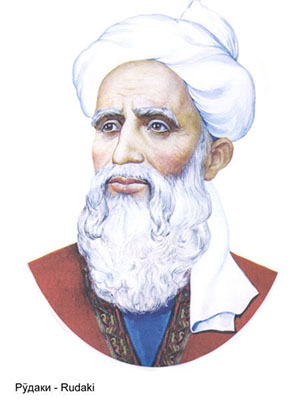
Halfway through my first glass of Prokupec my thoughts drifted, perhaps inevitably, to the Persian Poet Rudaki (858 a.d – 941 a.d.), the favorite poet of the Samanids of Bukhara, in what is now Uzbekistan. The Elton John of his Age, at one point Rudaki owned two hundred slaves who attended to his every need, and a hundred camels were necessary to carry his baggage when he traveled. His verses, it was said, filled a hundred volumes; he reportedly wrote 1,300,000 couplets. Almost all of his work has been lost. Unfortunately, the poet came to a bad end. He may have fell under the sway of the Ismaili Sect, considered heretical in the domains of the Samanids, and he eventually fell out of favor with the court. His lament:
Who had greatness? Who had favour, of all people in the land?
I it was had favour, greatness, from the Saman scions' hand;
Khurasan's own Amir, Nasr, forty thousand dirhams gave,
And a fifth to this was added by Prince of Pure and Brave;
From his nobles, widely scattered, came a sixty thousand more;
Those the times when mine was fortune, fortune good in plenteous store.
Now the times have changed--and I, too, changed and altered must succumb,
Bring the beggar's staff here to me; time for staff and script has come!
He reportedly died in abject poverty. Perhaps in his final days he repeated one of his couplets:
Were there no wine all hearts would be a desert waste, forlorn and black,
But were our last life-breath extinct, the sight of wine would bring it back.
 |
| Rudaki |

A white wine, Zilavka, that I tried earlier. It is also indigenous to the Balkan Peninsula. I am not a big fan of white wine, but this one was not bad at all. It was flirtatious but not presumptuous; sassy, without being impertinent.
 |
| Another view of the winery |