Friday, April 4, 2025

Uzbekistan | Khoresm | Zoroastrians | Tower of Silence

Zoroastrianism, founded in Persia in perhaps the 6th century BC by the mysterious character known as Zoroaster, a.k.a Zarathustra of “Thus Spoke Zarathustra” fame, is probably the world’s oldest “revealed” religion, and as such Zoroastrians are even regarded as “People of the Book”, along with Christians and Jews, by at least some Muslims (sorry, Buddhists remain garden-variety Idolators). The major premise of Zoroastrianism, as you no doubt know, is the vast cosmic struggle between Ahura Mazdah, the God of Light (very roughly speaking), and Ahriman, the principal of Darkness and Evil. Zoroastrianism was very widespread in the Transoxiania and Khorezm regions before the arrival of the Islam in the eight and ninth centuries. For an utterly titillating account of Zoroastrianism see In Search of Zarathustra. For still more see Magi

Zoroastrian Burial Practices are of special interest. Bodies were placed on high hills or man-made summits and exposed to scavengers who soon stripped the bones clean. The bones were then preserved in containers known as ossuaries. A high place where the bodies were laid out was known as a Tower of Silence. One such Tower of Silence is located on the right bank of the Amu Darya River northeast of Khiva. After my stay in Khiva I wandered by this Tower of Silence.
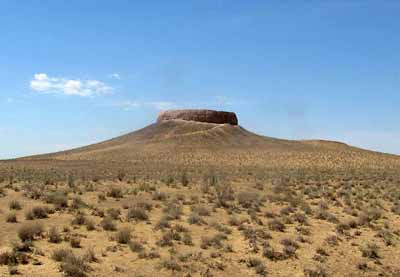
Tower of Silence on the north bank of the Amu Darya 

This particular Tower of Silence a man-made structure on top of a natural hill

Closer view of the man-made platform at the top of the hill

The south side of the platform

View south from the entranceway

The flat top of the burial platform with the Amu Darya in the distance

Another view of the flat top of the platform. Bodies were left here to be stripped down to the bones by vultures.

Irrigated lands next to the Amu Darya

Another view of irrigated lands next to the Amu Darya

The Amu Darya from the top of the Tower of Silence

Thursday, March 6, 2025

Italy | Venice | Ca’ Rezzonico

Wandered by the Ca’ Rezzonico on the Grand Canal. The palazzo dates back to the 1660s, although it did not achieve its present look until the 1750s. The original owner went bankrupt trying to complete it. After changing hands several times it was bought in the 1880s by Robert “Pen” Barrett Browning, son of Victorian poets Robert Browning and Elizabeth Barrett Browning, with money from his American heiress wife Fannie Coddington, who was said to be enthralled by the elder Brownings, famous poets that they were, but by Pen not so much. He won her hand and dollars only after a fourteen-year courtship. Pen cut a somewhat ambiguous figure. According to one recent author, “Pen Browning was destined to spend his adult life watching people register the thought, ‘That’s what those two poetic geniuses produced?’ but his parents considered him a marvel of aesthetic discernment and religious piety.” The American author and Venetomaniac Henry James, who knew Pen and his father personally and attended poetry readings at the palazzo, weighted in with this:
[The palazzo is] altogether royal and imperial—but ‘Pen’ isn’t kingly and the train de vie remains to be seen. Gondoliers ushering in friends from pensions won’t fill it out . . . There seems but one way to be sane in this queer world—but there are so many ways of being mad. And a Palazzo-madness is almost as alarming—or as convulsive—as an earthquake—which indeed it essentially resembles.”
Pen’s famous father died here on December 12, 1889. Later Pen was accused of having an affair with a blonde Italian bombshell by the name of Minerva who he had introduced into the household as a housekeeper-cum-model (he dabbled in painting and sculpture). He also installed a menagerie of birds, snakes, and other wildlife, turning the palazzo into a zoo, both literally and figuratively. Fanny finally got fed up and fled with her dollars, but the two never divorced. Pen sold the Ca’ Rezzonico in 1906 and retired to Asolo, the famous hill town on the mainland, where he died on July 8, 1912. 

The new owners let out the palazzo to, among others, the American composer and entertainer Cole Porter, who rented it in the mid-1920s for $4000 a month, $58,500 a month in today’s money. It was here that he held his notorious bacchanalias that shocked locals and bedazzled the ex-pat community. One frequent guest at his parties was Ada Beatrice Queen Victoria Louise Virginia Smith, a.k.a “Bricktop”(due to her red hair), a half-black-half-Irish jazz singer, dancer, and nightclub owner born in a small town in West Virginia who had washed up in Paris, where Porter met her in a nightclub and invited her to the Ca’ Rezzonico to teach his other guests the Charleston, the latest dance craze from the States.  The palazzo is now a museum and the visitants are much more sedate.
Ca’ Rezzonico (click on photos for enlargements)
Plaque commemorating Robert Browning’s death at Ca’ Rezzonico. It includes the famous line from one of his poems: Open my heart and you will see graved inside of it ‘Italy’.
Ca’ Rezzonico
The Grand Canal from the front of Ca’ Rezzonico
On the top floor of the palazzo is a gallery full of titillating paintings by Venetian artists. No museum in Venice can match it for the sheer amount of mammaries on display. This is just a sampling:

Nightmare date?
The word “louche” springs to mind
What’s going on with the asp?
Some guys have all the luck . . .
You can’t help but envy the little fella
Redheads. What can you say?
Call SVU!
Nice bellybutton!
The guy on the right is obviously a satyr, but what’s with the little cherub on the left?
Aphrodite (a.k.a. Venus) emerging from her clam shell. I was especially intrigued by this painting, since I have visited Aphrodite’s birthplace on Cyprus Island.

Monday, February 24, 2025

China | Xinjiang | Khotan | Carpet Factory

Wandered by the carpet factory in Khotan. A friendly Uighur woman who spoke a little bit of English explained to me what was going on. Although they made the silk carpets here for which Khotan is so famous, at the moment they were making only wool carpets. They use both Chinese and Uighur designs. A 1.2 x 1.8 meter wool carpet takes two people two months to make. A 3.3 x 4 meter carpet takes five people two months to make. A mammoth 15 by 20 meter (50 by 65 feet) carpet, one of the largest ever made here, and now on the wall of the Great Hall of the People in Beijing, took fifteen people four months to make. In the sales room (where, curiously, photography was not allowed) I was shown a 4.3 by 6.8 meter (14 by 22 feet) carpet selling for about $2400). This was wool of course. Silk carpets are much, much more expensive. A four-by-six-foot silk carpet could easily sell for $6000-$8000 even here in the factory. Back in Urumqi, in the carpet store at the Provincial Museum, I was shown a 14 by 22 inch rug (that’s inches, mind you) that was selling for a whopping $5800). This was a 1200 knots per inch with a very special design. Obviously this small piece was intended as a wall hanging, a work of art, and not a carpet to be trod on; it was barely big enough to serve as a door mat.

 Women working in the carpet factory 
  Woman working in the carpet factory
  Woman working in the carpet factory
 Women working in the carpet factory
Even back in Beijing I had been informed by knowledgeable people that the women in Khotan are renowned all over Xinjiang for their beauty. My friend, a Uighur from Ili, in northern Xinjiang, could not keep a note of envy, even jealousy, out of her voice when talking about the women of Khotan. Such eyes! Like amber and obsidian! Such hair! Like Khotanese silk (of course)! Such eyebrows! Like young willow leaves! Such straight noses! Like carved from jade! Such lips! Like ripe pomegranates! Such breasts! Like Hami melons! she kept raving. All Xinjiang men want a wife from Khotan, she claimed. Xuanzang, the peripatetic Chinese monk who visited here in 644, was noticeably silent on this issue, however. Marco Polo also visited Khotan, in the thirteenth century, and although he had much to say about the women of Hami—another town in Xinjiang—who were renowned for their unbridled sensuality, if not necessarily for their beauty, apparently none in Khotan caught his fancy, or at least none that he cared to write about.
 Khotanese beauty working in the carpet factory. Note the young-willow-leaf-like eyebrows and carved-from-jade-like nose.
Another Khotanese beauty working in the carpet factory. Note the amber-and-obsidian-like eyes.

Thursday, August 29, 2024

Monday, January 1, 2024

Iran | Yazd | Carpets

While in Yazd I wandered by a complex of shops selling pottery, brass and copper work, fabrics, clothes, carpets, and other items of interest to tourists, gadabouts, and pilgrims, both domestic and international. 
Courtyard of the shopping complex (click on photos for enlargements)
Pottery for sale at the complex
I was most interested in carpets. Stepping into one store I was surprised to see a selection of carpets very much like some that I already had in my hovel in Zaisan Tolgoi. I had bought mine in Bukhara, Uzbekistan, however. “Where are these carpets made?” I asked. I fully expected the salesmen to say “Yazd”, since most visitors are interested in buying locally made products. Instead he answered, “They are made in Serakhs.” “Serakhs, Iran, or Serakhs, Turkmenistan?” I wondered. The salesmen smiled, “Probably both.”
Salesmen in carpet store
I have of course been in Serakhs, Turkmenistan, since it was one of the cities trashed by Chingis Khan’s son Tolui in 1221. I did not have an Iranian visa at the time, so I could not visit Serakhs in Iran, which is right across the border. Nor did I have time to check out carpets stores, as my Turkmenistan visa was expiring and I had to get back to Ashgabat.
Ruins of the ancient city of Serakhs, destroyed by Tolui. The modern city is nearby, with a sister city just across the border in Iran.
Serakhs carpets in Yazd
Serakhs carpets  in Yazd
Serakhs carpets
Serakhs carpets  in Yazd
These kinds of carpets, single knotted silk, with emphasis on the color red, are often called “Bukhara Carpets” or “Bukharans”, after Bukhara in Uzbekistan. They were given these names because they were commonly sold in Bukhara, one of the great Silk Road emporiums, not because they were made there. Even today dealers in Bukhara will try to tell you that they are made in Bukhara, but even the most cursory investigation will prove this not to be true. The salesmen in the stores adamantly stick to this story, however. Someone else in Bukhara, a salesman in a store selling hand-woven fabrics who appeared to have a grudge against the carpets guys, warning me that they were dyed-in-the-wool liars and not to believe a word they said about anything, told me that it was common knowledge among local merchants that the carpets in question came from Serakhs, in Turkmenistan.  I seem to have found proof of this assertion here in Yazd. 
Carpet Store in the Abdullah Khan Tim in Bukhara 
“Bukharan” carpets in the Abdullah Khan Tim. In all likelihood they were made in Serakhs.
“Bukharan” carpets
“Bukharan” carpets
A “Bukharan” carpet, probably made in Serakhs, on the floor of my hovel in Zaisan Tolgoi, Mongolia.
Regardless of where they are made, they are gorgeous carpets. I showed one to some Carpet Guys In Istanbul and they grudgingly admitted—they are not big fans of single-knot carpets—that they were of excellent quality. One dealer even offered me cash for one. The profit would have covered my plane ticket to Ashgabat, but I passed. I certainly do not want to become even a part-time carpet dealer, a profession which on the social scale is only slightly above pimps, prostitutes, bartenders, and lawyers. 

Sunday, December 17, 2023

Italy | Venice | Palazzo Rizzi


Wandered by Venice and am back in my usual digs, an old nunnery which has been converted into a hotel. The building, once the Palazzo Rizzi, is located on the Fondamenta Rizzi, about a five minute walk from the Piazzale Roma, where all buses from the mainland terminate. The hotel is still owned and operated by St. Joseph’s Daughters of Caburlotto, the religious order that occupied the nunnery. As befitting an old nunnery, the rooms are tiny and spartan, to say the least. My bed is about three feet wide—all that was needed by a nun—and my ankles hang over the end, but the room does have a desk and enough electrical outlets to keep all my devices topped up. What else does one need in a room? There is also a midnight to 6:00 a.m. curfew. You cannot enter or leave the building during those hours. This is of no importance to me. Venice is not a night-life city by any stretch of imagination, and I myself would never have any reason to stay out past midnight. The Fondamenta Rizzi, the walkway on which the hotel is located, does not even have a convenience store and is as quiet as Ligeia’s tomb after nine p.m. 

Fondamenta Rizzi on the right (click on photos for enlargements)
The old Palazzo Rizzi, later a nunnery and now a hotel
Venice
Venice. The leaning bell tower is not a photographic distortion. It actually does lean that way.
Canal of San Luca
The Piazzetta in Venice
Piazza and Church of San Marco
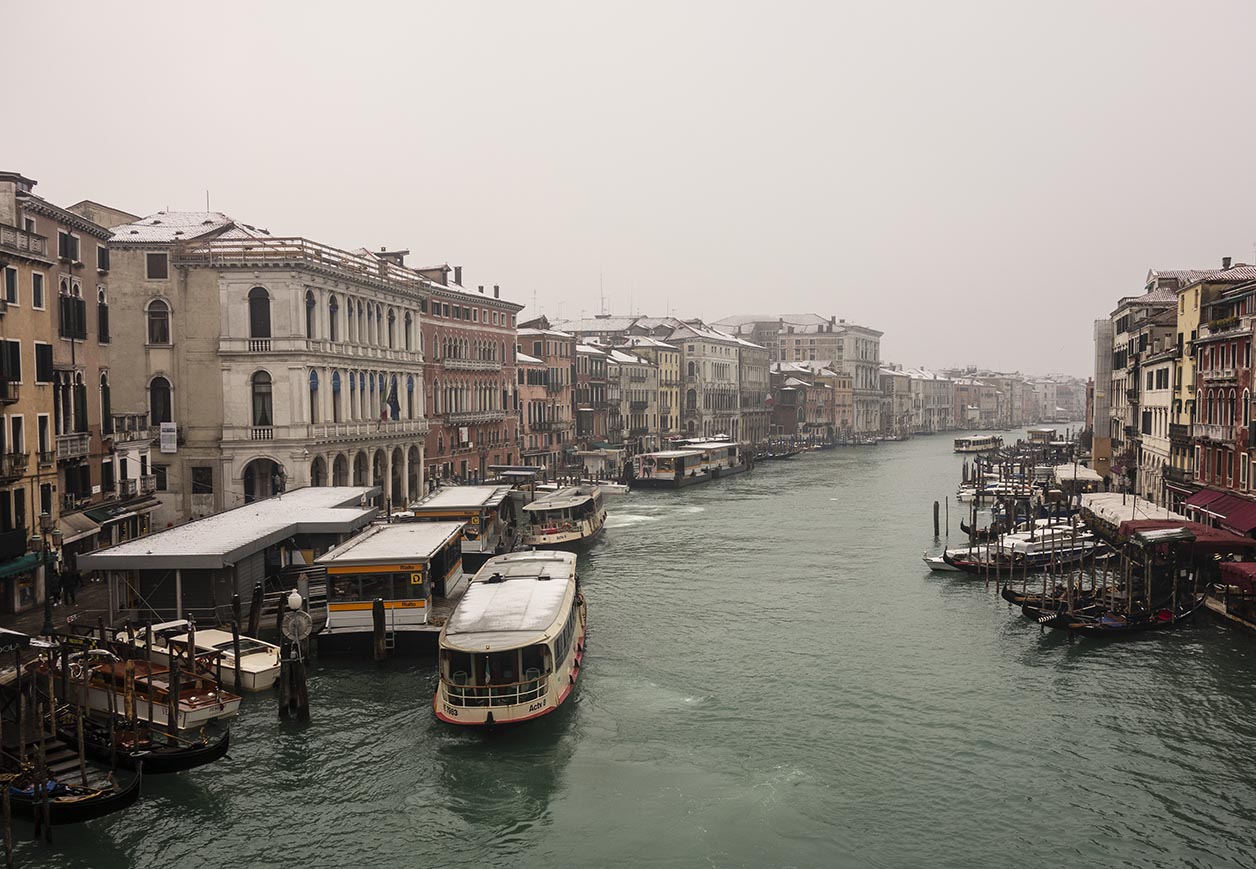
Grand Canal from the Rialto Bridge