Saturday, May 9, 2026

Italy | Venice | Palazzo Mocenigo

Wandered by the Museum of Palazzo Mocenigo, just behind the Church of San Stae on the Grand Canal. The museum also hosts the Study Centre of the History of Textiles, Costumes and Perfume. The museum and study center is housed in the former palazzo of the Mocenigos, one of the most prominent families in Venice for a period of several hundred years. Seven Mocenigos became doges: Tommaso (1414–23), Pietro (1474–76), Giovanni (1478–85), Alvise I (1570–77, Alvise II (1700-1709), Alvise III (1722-32), and Alvise IV (1763). There were two branches of family, one located here at San Stae and another further on down the Grand Canal at San Samuele. A member of the San Samuele branch, Giovanni Mocenigo, was notorious for denouncing irrepressibly hard-core pantheist and unapologetic Hermetic occultist Giordano Bruno to the Catholic Inquisition, which resulted in Bruno being burned at the stake in Paris on Ash Wednesday, February 17th, 1600.
Church of San Stae
Entrance to Palazzo Mocenigo
Costume Exhibit (click on photos for enlargements)
Costume Exhibit
Costume Exhibit

Costume Exhibit
Costume Exhibit
Book of perfume recipes plus raw ingredients for making Perfume. I was of course in Seventh Heaven here. 

Thursday, May 7, 2026

Türkiye | Tur Abdin | Mor Gabriel Monastery

After visiting Midyat we wandered down to Mor Gabriel Monastery, twelve miles southeast of Midyat and fifteen miles north of the Syrian border. Here, at least, Syriac Christianity appears to be surviving. This is one of the oldest monasteries in the world. It was founded in 397 by Mor (saint) Samuel (d. 433) and Mor Simon (d. 409). Originally it was called the Monastery of Mor Samuel and Mor Simon, but in the seventh century it was renamed Mor Gabriel Monastery after Mor Gabriel (634-668), the bishop of the Tur Abdin Region. Except for brief periods during wars and civil disorders the monastery has operated continuously since the year 397. Visitors are not allowed to wander around the grounds by themselves (although you can stay overnight if you make previous arrangements), but a guide is provided to give you a tour. Our guide, a young Syriac Christian, spoke perfect, unaccented English. 

Entrance to the monastery (click on photos for enlargements)

Entrance to the courtyard

Inner courtyard of the monastery

Monastery grounds

Steeples

This circular room, a later addition to the original monastery, was built in the sixth century with funds provided by the notorious Empress Theodora, the wife of Byzantine Emperor Justinian I

Circular Room. The small windows on the dome open on monks’ cells. 

Our guide related that Theodora was born near here, in what is now Syria, and that her father was a Syriac priest. It was this connection with the area and the Syriac Church that motivated her to make a sizable donation to the monastery for the purpose of building this room. This is the sanitized version of Theodora’s background. Most sources do agree that she was born in Syria, but many maintain that Theodora was the daughter of a bear trainer and a professional dancer and actress. They began pimping out Theodora and her sister Komito when they were both pre-adolescents. Theodora quickly began one of Constantinople’s most notorious prostitutes. If we are to believe the Byzantine historian Procopius (c. AD 500 – c. AD 565), who probably knew her personally, Theodora engaged in behaviour which would make even Kim Kardashian blush.

None of this mattered to Emperor Justinian, who became besotted with Theodora and eventually married her. As the wife of a Byzantine emperor Theodora might well have wanted to upgrade her image by donating money to religious institutions. Thus she has been memorialized here at Mor Gabriel Monastery. Justinian himself initiated the construction of Aya Sofia in Istanbul, to this day one of the most magnificent religious structures in the world. Maybe he was feeling guilty about marrying a nymphomaniacal prostitute and wanted to do something to atone for it?

Theodora (c. 500 – 28 June 548) portrayed on a mosaic in a church in Ravenna, Italy (not my photo)

This was probably the dining hall in the monastery

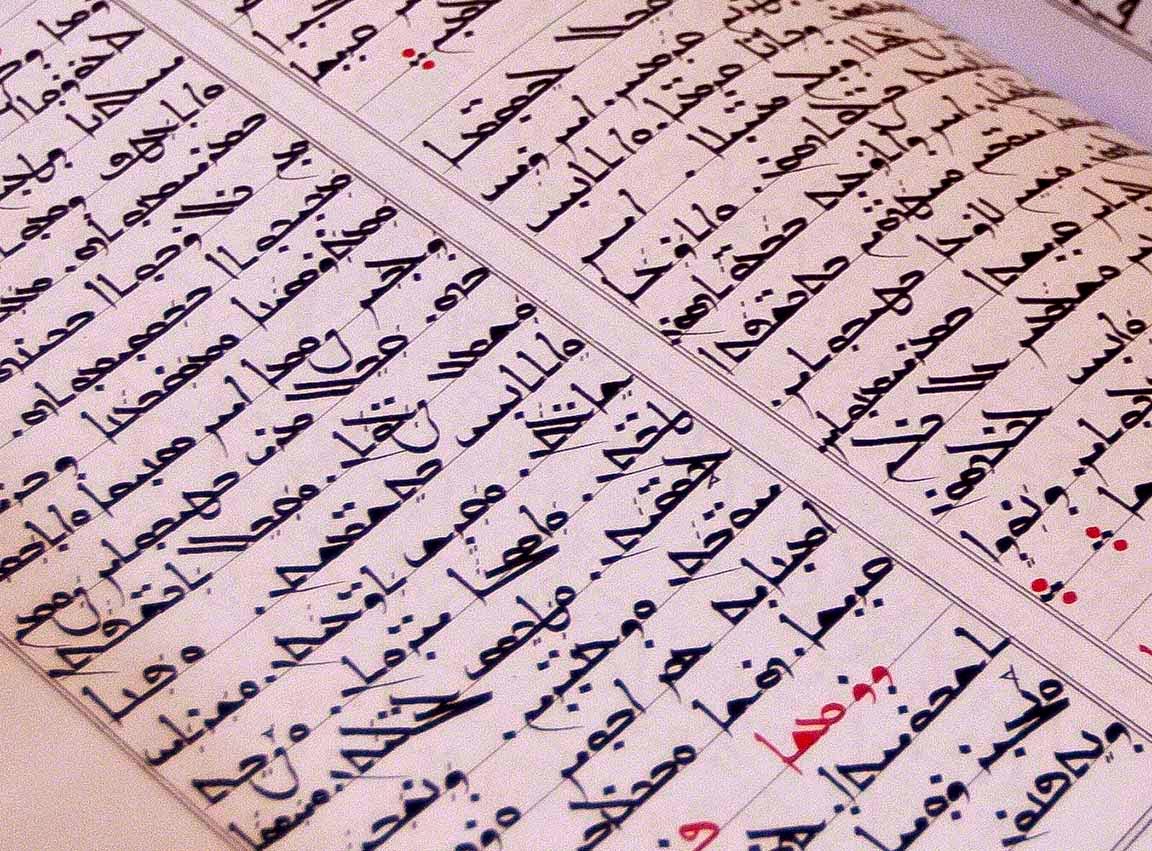
A book, I believe a Bible, but I am not sure, in Syriac Script. The Syriac Language is closely related to Aramaic, the language spoken by Jesus of Nazareth, leader of the Galileans.

The Syriac Script was based on the ancient Aramaic Script. The Sogdians of Inner Asia adapted the Syriac Script into their own Sogdian Script; the Uighurs in what is now Xinjiang Province in China adapted the Sogdian Script into their own Uighur Script; and later the Uighur Script was used as the basis for the Traditional Mongolian Script. Thus the Mongolian Vertical Script, which is experiencing somewhat of a revival in Mongolia, can be traced back to the ancient Aramaic Script, a variation of which is still used by Syriac Christians in Turkey today. 
Closer view of Syriac Script. 
A Syriac inscription on a wall in the monastery

New addition to the monastery. Local stone carvers and masons have lost none of their traditional skills.
Good example of local stonework

Wednesday, May 6, 2026

Turkey | Nusaybin | White Water | Beyazsu | Fish Restuarant

After visiting Nusaybin and the Church of St. Jacob on the Turkish-Syrian border we stopped at one of the famous fish restaurants on the Beyazsu (White Water) River north of  the city.

Most of the restaurants on the Beyazu grow their own trout in water tanks fed by the Beyazsu River (click on image for enlargements).

Trout in the tanks. After you order they are netted and prepared for the table.

Most of the restaurants feature river-side dining.

River-side tables

River-side tables

River-side table where we dined

You might think this place was just for show and that the food would be an afterthought, but not so. This was one of the better restaurant meals I have had in years. Actually we ordered the Kurdish equivalent of Surf-n-Turf. The lamb kabobs are not shown here.

Saturday, April 25, 2026

USA | Allegheny Mountains | Spring Ephemerals

Foraging season for Spring Ephemerals in the Allegheny Mountains is reaching its peak. Ramps are looking great. Traditionally they are said to peak on Mother’s Day, which this year is on May 10,  but in recent years plants have been up to two weeks ahead of schedule due to our changing climate.

Ramps

A nice Spring dish of Garlic Mustard, Dandelion, Ground Ivy, and Ramps

The corm of Spring Beauties. Resembling a tiny potatoes, they are known in some circles as Fairy Spuds. A tasty little treat.

Monday, April 13, 2026

USA | Allegheny Mountains | Trout Season | Ramps

Trout Season opened last Saturday. A local Waltonian stopped by my Retreat and dropped off two rainbow trout he had caught. True, they were hatchery-raised and stocked in a stream for sports fishermen, but who am I to look a gift horse in the mouth. 

Rainbow trout and ramp leaves (click on photos for enlargements)

I also pickled the bulbs and the lower stems of some ramps in a brine of one-half water and one-half vinegar with one teaspoon of turbinado sugar, one teaspoon of Mongolian lake salt, and two sassafras leaves (used as a substitute for bay leaves; both sassafras and bay belong to the same botanical family). 

Pickled ramps

As a side dish to the trout I made some lentils and Basmati rice with steamed (not boiled) ramp leaves and pickled ramp stems and bulbs as a garnish. 

Thursday, April 9, 2026

USA | Allegheny Mountains | Ramps

Ramps Season has begun! For many foragers ramps (Allium tricoccum) are the Holy Grail of edible plants. I located a dozen or more small colonies of ramps along a small tributary of the Casselman River.

Tributary of the Casselman River (click on photos for enlargements)

A nice colony of ramps next to a convenient brooklet for washing them.

A small colony of ramps

Another colony of ramps

Ramps

Ramps

Most ramp plants have two leaves. One leaf can be harvested from a plant without killing it.

The whole ramp plant. Authorities recommend harvesting no more than 10% of a colony to ensure its long-term health. I never harvest more than 5%. The leaves and bulbs can be used in any way you would use onions.

Iran | Yazd

Wandered by Yazd, a city of about one million people located near the middle of Iran. It is known as one of the hottest cities in the country. As with many cities in the desert water is held in high regard. 
 Main square of Yazd (click on photos for enlargements)
 Main square of Yazd
 Main square of Yazd
Kids playing in the main square of Yazd. The city’s famous wind-catchers, which catch cool breezes and funnel them down into the buildings below, can be seen in the background. The wind-catchers were an early form of air-conditioning. 
 Skyline of Yazd with more wind-catchers
Wind-Catchers
Streets of Yazd
 Mosque in Yazd
 Detail of mosque in Yazd
  Detail of mosque in Yazd
 Hotel where I stayed in Yazd
 Courtyard of hotel where I stayed in Yazd
  Courtyard of hotel where I stayed in Yazd
Courtyard of hotel where I stayed in Yazd. The perfect place for sipping a saffron tisane as the air cools off at twilight.