Wednesday, May 6, 2026

Mongolia | In Search of Shambhala: The 1925-1928 Roerich Expedition in Ulaanbaatar, Mongolia

The 1925-1928 Roerich Expedition, led by artist, mystic, spy, arch-intriguer, and hard-core Aghartian-Shambhalist Nicholas Roerich, was believed by some to be a khora, or circumnavigation, of the legendary kingdom of Shambhala. The Expedition spent seven months in Ulaanbaatar, the capital of Mongolia. Everywhere they turned the Roerichs stumbled upon signs of Shambhala . . . Continued . . .


Mongolia | False Lama of Mongolia: The Life and Death of Dambijantsan

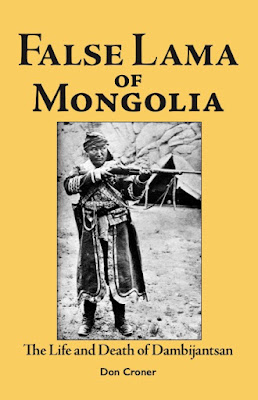
Who was Dambijantsan?

A Buddhist monk; a freedom fighter for Mongolian independence; the descendant of Amursanaa (1723–1757), the Western Mongol who led the last great uprising against the Qing Dynasty of China; the incarnation of Mahakala, the Buddhist god of war; bandit, torturer, murderer, or evil incarnate? During his lifetime no one was sure who he really was, and even today the controversy about his life continues.

Born in what is now the Republic of Kalmykia, part of the Russian Federation, Dambijantsen traveled throughout Tibet, India, and China before arriving in Mongolia in 1890 where he tossed gold coins to bystanders and announced to one and all that he had come to free Mongolia from the yoke of the Qing Dynasty of China. After disappearing almost twenty years he returned to lead the attack on Khovd City, the last Chinese outpost in Mongolia. Honored by the Eighth Bogd Gegeen, the theocratic leader of Mongolia, for his efforts in achieving Mongolian independence, he went on to establish his own mini-state in western Mongolia, which he hoped to use as a base for establishing a Mongol-led Buddhist khanate in Inner Asia. His dictatorial nature and unbridled sadism soon came to the fore and he was finally arrested and imprisoned in Russia. After the Russian Revolution he returned to Mongolia, gathered new followers around him, and established a stronghold at the nexus of old caravan routes in Gansu Province, China. He robbed caravans, grew opium, and once again dreamed of creating a new Mongolian khanate in Inner Asia. Finally the new Bolshevik government in Mongolia, fearful of his rising power, issued orders for his assassination. Dambijantsan transmigrated in 1922, but in Mongolia legends persist to this day that his spirit still rides on the winds of the Gobi and continues to haunt his former lairs.


Turkey | Nusaybin | White Water | Beyazsu | Fish Restuarant

After visiting Nusaybin and the Church of St. Jacob on the Turkish-Syrian border we stopped at one of the famous fish restaurants on the Beyazsu (White Water) River north of  the city.

Most of the restaurants on the Beyazu grow their own trout in water tanks fed by the Beyazsu River (click on image for enlargements).

Trout in the tanks. After you order they are netted and prepared for the table.

Most of the restaurants feature river-side dining.

River-side tables

River-side tables

River-side table where we dined

You might think this place was just for show and that the food would be an afterthought, but not so. This was one of the better restaurant meals I have had in years. Actually we ordered the Kurdish equivalent of Surf-n-Turf. The lamb kabobs are not shown here.

Wednesday, April 29, 2026

Uzbekistan | Seven Saints of Bukhara


According to the thirteen-century Persian historian Ata-Malik Juvaini, Bukhara, the city in what is now the country of Uzbekistan, “is the cupola of Islam and is in those regions like unto the City of Peace [Baghdad] . . . Since ancient times it has in every age been the place of assembly of the great savants of every religion.”


In the twelfth, thirteenth and fourteenth centuries seven remarkable men lived in Bukhara and the surrounding Bukhara Oasis. These men were known as the Khwajagan, or Masters of Wisdom. The Seven Khwajagan are: Abd al-Khaliq al-Ghujdawani (1103–1179); Arif ar-Riwakri (1136-1239); Mahmud al-Injir al-Faghnawi (d.1317);Ali ar-Ramitani (d.1315/1321); Muhammad Baba as-Sammasi (d.1354); Sayyid Amir Kulal (1287?–d.1370); Bahauddin Shah Naqshband (1318–1388?)

The Khwajagan remain to this day revered as the Seven Saints of Bukhara, and their mausoleum complexes continue to be visited by pilgrims and travelers from all over the world.

Saturday, April 25, 2026

USA | Allegheny Mountains | Spring Ephemerals

Foraging season for Spring Ephemerals in the Allegheny Mountains is reaching its peak. Ramps are looking great. Traditionally they are said to peak on Mother’s Day, which this year is on May 10,  but in recent years plants have been up to two weeks ahead of schedule due to our changing climate.

Ramps

A nice Spring dish of Garlic Mustard, Dandelion, Ground Ivy, and Ramps

The corm of Spring Beauties. Resembling a tiny potatoes, they are known in some circles as Fairy Spuds. A tasty little treat.

Sunday, April 19, 2026

Mongolia | Zanabazar | First Bogd Gegeen of Mongolia


Zanabazar (1635–1723) was, according to most reckonings, the sixteenth incarnation of Javsandamba. The first incarnation is believed to have appeared around the time of the Buddha. As a small boy he was recognized as the spiritual leader of Mongolia and awarded the title of Bogd Gegeen. He would go on to play a role in the religious and political life of Mongolia analogous to that of the Dalai Lamas of Tibet. Zanabazar built temples and established monasteries, including one at what is now the site of Ulaanbaatar, the capital of Mongolia, and was a polymath who invented new scripts for writing the Mongolian language, designed new clothes for monks, studied the medical properties of hot springs, and much else. He is most famous for his bronze statues which are now the centerpieces of three museums in Ulaanbaatar. “During his lifetime, he was the greatest Buddhist sculptor in Asia,” opines art historian K. Youso about Zanabazar.” Indeed, he is often called the Michelangelo of Mongolia. Zanabazar was the first of Mongolia’s nine Bogd Gegeens. The Ninth Bogd Gegeen transmigrated on March 1, 2012.  During a visit to Mongolia on November 23, 2016, the Fourteenth Dalai Lama announced that the Tenth Bogd Gegeen had been born and that attempts were being made to identify him. Update: The Tenth has now been named. See Tenth Incarnation.


See The Life of Zanabazar

United States | Maryland | Great Allegheny Passage | Cumberland | Mount Savage | Frostburg

In Cumberland, Maryland, the Spring, or Vernal, Equinox occurred at 11:06 p.m. on March 19, according to the Gregorian calendar imposed on the Occidental world by Pope Gregory XIII in 1582. The Equinox marks the astrological astronomical beginning of the spring season in the Northern Hemisphere. It’s often said that the Spring Equinox is when day and night are of equal length. Actually, due to an astronomical quirk, the date when day and night are equal, known as the Equilux, is usually a few days before the Equinox. This year March 15 has eleven hours, fifty-nine minutes, and fifty-five seconds of daylight. The next day has twelve hours, two minutes, and thirty-one seconds of daylight, so the pendulum has already swung toward longer days. The day of the Equinox has twelve hours, ten minutes, and twenty-four seconds of daylight. The next day has twelve hours, thirteen minutes, and zero seconds, making it two minutes and thirty-six seconds longer than the day before. The procession is on to the Summer Solstice, the longest day of the year, on June 20. I have decided that between the Spring Equinox and the Summer Solstice I will wander on the Great Allegheny Passage, a bike and hiking trail built on the roadbeds of now-abandoned railroads that extends 150 miles from Cumberland to Pittsburgh, Pennsylvania. Another trail, the C&O Canal Towpath, runs 184.5 from Cumberland to Washington, D.C, making it possible, in season, to ride a bike—or hike, if you are so inclined—334.5 miles from Pittsburgh to Washington. No motorized vehicles (except for electric bikes) are allowed on the entire path. Before proceeding on the GAP I will first explore the city of Cumberland . . . Continued.


Monday, April 13, 2026

USA | Allegheny Mountains | Trout Season | Ramps

Trout Season opened last Saturday. A local Waltonian stopped by my Retreat and dropped off two rainbow trout he had caught. True, they were hatchery-raised and stocked in a stream for sports fishermen, but who am I to look a gift horse in the mouth. 

Rainbow trout and ramp leaves (click on photos for enlargements)

I also pickled the bulbs and the lower stems of some ramps in a brine of one-half water and one-half vinegar with one teaspoon of turbinado sugar, one teaspoon of Mongolian lake salt, and two sassafras leaves (used as a substitute for bay leaves; both sassafras and bay belong to the same botanical family). 

Pickled ramps

As a side dish to the trout I made some lentils and Basmati rice with steamed (not boiled) ramp leaves and pickled ramp stems and bulbs as a garnish. 

Thursday, April 9, 2026

USA | Allegheny Mountains | Ramps

Ramps Season has begun! For many foragers ramps (Allium tricoccum) are the Holy Grail of edible plants. I located a dozen or more small colonies of ramps along a small tributary of the Casselman River.

Tributary of the Casselman River (click on photos for enlargements)

A nice colony of ramps next to a convenient brooklet for washing them.

A small colony of ramps

Another colony of ramps

Ramps

Ramps

Most ramp plants have two leaves. One leaf can be harvested from a plant without killing it.

The whole ramp plant. Authorities recommend harvesting no more than 10% of a colony to ensure its long-term health. I never harvest more than 5%. The leaves and bulbs can be used in any way you would use onions.

Iran | Yazd

Wandered by Yazd, a city of about one million people located near the middle of Iran. It is known as one of the hottest cities in the country. As with many cities in the desert water is held in high regard. 
 Main square of Yazd (click on photos for enlargements)
 Main square of Yazd
 Main square of Yazd
Kids playing in the main square of Yazd. The city’s famous wind-catchers, which catch cool breezes and funnel them down into the buildings below, can be seen in the background. The wind-catchers were an early form of air-conditioning. 
 Skyline of Yazd with more wind-catchers
Wind-Catchers
Streets of Yazd
 Mosque in Yazd
 Detail of mosque in Yazd
  Detail of mosque in Yazd
 Hotel where I stayed in Yazd
 Courtyard of hotel where I stayed in Yazd
  Courtyard of hotel where I stayed in Yazd
Courtyard of hotel where I stayed in Yazd. The perfect place for sipping a saffron tisane as the air cools off at twilight. 

Tuesday, March 31, 2026

Iran | Esfahan | Abbasi Hotel

Wandered down to Esfahan, south of Tehran. I was especially looking forward to visiting Esfahan since I had booked a room at the legendary Abassi Hotel, which if not the city’s best hotel is certainly the most historic and picturesque.
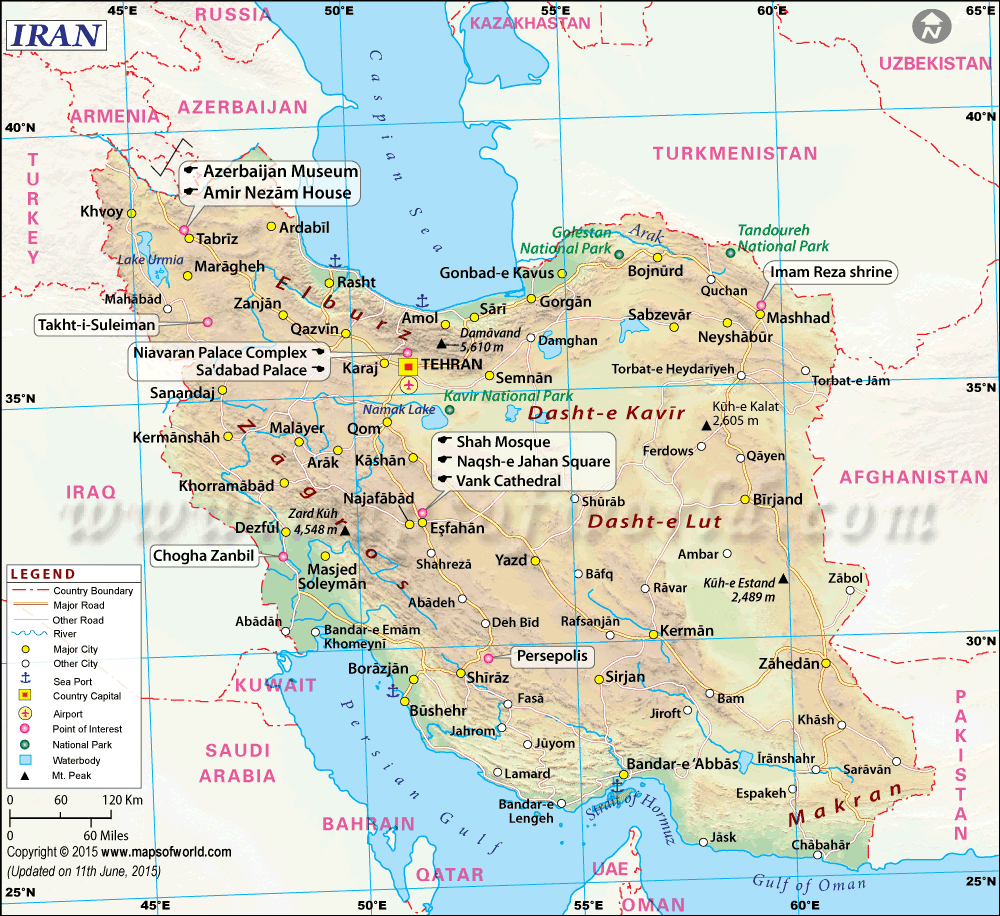
Location of Esfahan (click on photos for enlargements).
The Abbasi Hotel was originally a caravanserai built during the time the the Safavid Sultan Husayn (1668—1726). It was restored and remodeled in the 1950s into an upscale hotel. Film buffs may recognize the hotel as the set for the 1974 movie Ten Little Indians starring Oliver Reed and German bombshell Elke Sommer. I had read some on-line reviews that groused about the small size of some of the rooms at the hotel. This was certainly not the case with my first floor room, which opened directly onto the courtyard. A troop of dancers, had one been available, could have bivouacked in the room with space left over for a camel or two. 
This etching was made in 1840. 
The basic layout of the building itself has changed very little since 1840. The two-story arched alcove near the right edge of the etching now hosts a charming little snack shop. The dome and minaret of the mosque seen looming over the top of the building are unchanged. Oh how I would have loved to have been in that courtyard when it still hosted camels! Note that the camels shown are Two-Humped Bactrians, the most noble of the world’s four-legged creatures, and not one-humped dromedaries. I would have had second thoughts about staying at the caravanserai if they had allowed in dromedaries, unless, of course, dromedaries were restricted to their own watering troughs.

Camels (Bactrian). You can’t help but love them.

Lobby of hotel. I took this photo at five o’clock in the morning. During the day and evening the lobby was a madhouse of milling tourists from England, Germany, Italy, Spain, China, and elsewhere. As far as I could tell I was the only American. 
Courtyard of hotel
Courtyard of hotel
Courtyard of hotel
Courtyard of hotel
Courtyard of hotel
Courtyard of hotel
Courtyard of hotel
I spent my late afternoons in the courtyard enjoying glasses of refreshing hibiscus tisane with rock sugar. Clinically proven to lower your blood pressure!
Hotel lobby coffee shop where I got my morning caffeine fix. In the afternoons it was jammed with Chinese tour groups.