Tuesday, January 31, 2012

Mongolia | Fifth of the Nine-Nines | Tavisan Budaa Khöldökhgui


The Fifth of the Nine-Nines—nine periods of nine days each, each period marked by some description of winter weather—began on January 27. This is Tavisan Budaa Khöldökhgui, the time when “Cooked Rice Cannot Be Frozen.” I must admit I really don’t understand the definition of this period. It seems to me that cooked rice would be frozen at any temperature below freezing, and we can certainly expect colder temperatures than that during the last week of January and beginning of February. Anyhow, the Fourth of the Nine-Nines was supposed to be coldest of the Nine-Nines, but this year the Fifth might well turn out to be colder. I have blogged in the past about the Magical Moment when 40 below zero are the same on the Fahreinheit and Celsius scales. The last few days we have been having a Magic Moment every morning.


This morning it dropped down to a frosty 45 below 0º F.


Some old Gray Beards I spoke with at the Bogd Khaan Winter Palace Museum yesterday assured me that this would be the coldest week of the year and that we might expect it to warm up just a bit before Tsagaan Sar, the Mongolian New Year, on February 22. In any case, it is good weather for people who are freezing their Buuz on the balcony in preparation for the Festive Day

Mongolia | Fifth of the Nine-Nines | Tavisan Budaa Khöldökhgui

The Fifth of the Nine-Nines—nine periods of nine days each, each period marked by some description of winter weather—began on January 27. This is Tavisan Budaa Khöldökhgui, the time when “Cooked Rice Cannot Be Frozen.” I must admit I really don’t understand the definition of this period. It seems to me that cooked rice would be frozen at any temperature below freezing, and we can certainly expect colder temperatures than that during the last week of January and beginning of February. Anyhow, the Fourth of the Nine-Nines was supposed to be coldest of the Nine-Nines, but this year the Fifth might well turn out to be colder. I have blogged in the past about the Magical Moment when 40 below zero are the same on the Fahreinheit and Celsius scales. The last few days we have been having a Magic Moment every morning.


This morning it dropped down to a frosty 45 below 0º F.


Some old Gray Beards I spoke with at the Bogd Khaan Winter Palace Museum yesterday assured me that this would be the coldest week of the year and that we might expect it to warm up just a bit before Tsagaan Sar, the Mongolian New Year, on February 22. In any case, it is good weather for people who are freezing their Buuz on the balcony in preparation for the Festive Day

Thursday, January 19, 2012

Mongolia | Fourth of the Nine Nines | Dönön Ükhiin Ever Khöldöne

Update: 40º below 0 F. at 8:00 am on Thursday the 19th and calling for 47º below 0º F. tonight. So the Fourth of the Nine-Nines is living up to its reputation as the coldest of the nine nine-day periods of winter weather.


The Fourth of the Nine-Nines, known as Dönön Ükhiin Ever Khöldöne—Time When Four Year-Old Cows’ Horns Freeze—begins today, January 18. This is supposed to be the coldest of the Nine-Nines, nine periods of nine days each, each period marked by some description of winter weather. It was 20 below F. (–29º C. for you unrepentant Celsius freaks) at 10:00 am, not especially cold for This Time Of The Year. But the forecast for this week is for much, much colder weather, maybe even record-setting. Stay tuned . . . 


Mongolia | Fourth of the Nine Nines | Dönön Ükhiin Ever Khöldöne

Update: 40º below 0 F. at 8:00 am on Thursday the 19th and calling for 47º below 0º F. tonight. So the Fourth of the Nine-Nines is living up to its reputation as the coldest of the nine nine-day periods of winter weather.

The Fourth of the Nine-Nines, known as Dönön Ükhiin Ever Khöldöne—Time When Four Year-Old Cows’ Horns Freeze—begins today, January 18. This is supposed to be the coldest of the Nine-Nines, nine periods of nine days each, each period marked by some description of winter weather. It was 20 below F. (–29º C. for you unrepentant Celsius freaks) at 10:00 am, not especially cold for This Time Of The Year. But the forecast for this week is for much, much colder weather, maybe even record-setting. Stay tuned . . . 

Friday, January 13, 2012

Chingis Khan Rides West | Flight of the Khorezmshah | Nishapur | Ray | Hamadan


As we have seen, the Khorezmshah spent almost a month Carousing with the Songstresses and Damels of Nishapur. These bacchanalias ended when word arrived that the Mongol pursuit party which had been sent to bring the Khorezmshah to heel was on the way. The Mongol commanders Jebe and Sübetei and their 30,000 men arrived at the walls of Nishapur in early June, after the Khorezmshah had already fled. They immediately sent an envoy into the city to met with local officials and demand food and other supplies. Three local envoys then came out to met Jebe and proffer gifts and provisions. They made an outward show of submission, but Jebe was not satisfied.  He harangued them about the futility of any further resistance and to reenforce his point he presented to the town fathers a copy of a decree in Uighur script from Chingis Khan, apparently stamped with his own seal,  which stated:


Whosover . . . shall submit, mercy will be shown to them and unto his wives and children and household; but whosoever shall not submit, shall perish together with all his wives and children and kinsmen.


The import of this decree seemed to be that although Jebe and Sübetei might ride on, the city must immediately submit to any other Mongol armies that arrived in the future. Chingis had probably already decided to invade Khorasan at this point, and was depending on Jebe and Sübetei—in addition to hounding down the Sultan—to soften up the region’s cities in advance. Indeed, according to one Chinese source, Jebe and Sübetei had been given specific order by Chingis not to actually invest any cities until he himself arrived in Khorasan. When sufficiently provoked, as at Zava, the two Mongol generals would overlook this order, but otherwise they were to keep their attention focused on the Khorezmshah.


By the time they reached Nishapur, however, it was clear that Jebe and Sübetei had lost the scent of their quarry. The Khorezmshah, in his desperation, was traveling fast and light, with only a small retinue and a few bodyguards and was covering his tracks well. Even the historians Al-Athir and Juzjani are unable to account for his movements at this point.


Jebe and Sübetei now decided to spilt up and head in different directions in hopes of coming across the Khorezmshah’ spoor. Jebe heading westward to the district of Juvain (home of our scribe, Juvaini) and the current-day city of Jagastai. Sübetei backtracked in case the Khorezm had somehow slipped around behind his pursuers. First he headed southeast to Jam (current-day Torbat Jam in Iran) and finding no sign of the Khorezmshah there then looped around northward towards Tus, near modern-day Meshed.


Realizing that the scent here had long gone cold, he hurried on to Quchan and then to Isfarayin, on the great east-west Trunk Road through Khorasan. According to Juvaini the Sultan had indeed passed through Isfarayin, and here Sübetei may have stumbled upon the traces of his trail. By now Sübetei’s patience was apparently wearing thin, however, and he no longer felt bound by his orders to stay in hot pursuit of the Sultan and not attack cities. He offered Quchan and Isfarayin the same terms he and Jebe had offered Nishapur, but they refused to submit and were subjected to savage assaults and massacres, according to Juvaini. He then moved on to Damghan, where he discovered that many of the town’s most prominent citizens had fled the city and taken refuge in the Ismaili stronghold of Gerdkuh.


The fortress of Gerdkuh, built on a precipitous massif some ten miles west of Damghan, was considered so impregnable that the Ismaili Hassan Sabbah, founder of the Assassin sect, sent his own family here for safe-keeping when his own stronghold of Alamut—itself legendary as an impenetrable redoubt—was under attack. Overlooking the Khorasan Trunk Road—the main artery of the Silk Road through Khorasan—the occupants of the castle had grown rich extorting fees from passing caravans. The living quarters of the fortress were extensive and a large number of people could live here for months, or years, if necessary. Later, in the 1250s, when Chingis Khan’ grandson Khülegü attacked the Ismaili strongholds what is now Iran, Gerdkuh held out the longest, withstanding a seventeen-year siege from 1253 to 1270.


Here the eminences of Damghan took refuge from Sübetei. Obviously he did not have time to invest and subdue such a formidable bastion as this. Instead he attacked the “ruffians”—Juvaini’s term—who had had remained behind in the city. These were soon routed by the Mongols. At this point Sübetei may have received intelligence that the Khorezmshah was in Ray, since he now headed straight for the city on the Great Trunk Road. 


Meanwhile Jebe, after rampaging through the Juvain district, had crossed the Elburz Mountains to the province of Mazandaran on the southern edge of the Caspian Sea and laid waste to Amol and other nearby cities and towns. He too learning of the Khorezmshah’s whereabouts, Jebe immediately abandoned his raid on Mazandaran and headed south to Ray. 


According to Nasavi, while on his way to Ray the Khorezmshah had stopped briefly in the city of Bistam (Bastam, in current-day Iran), located almost exactly halfway between Nishapur and Ray, on the southern edge of the Elburz Mountains and famous as the birthplace of Bayazid Bastami (804-874?), one of the first of the so-called Intoxicated Sufis. Here he met with the local governor Taj al-din Omar Bistami and handed over to him two chests filled with precious jewels with instructions that the treasure should be taken for safe-keeping to the fortress of Ardahn, described by Nasavi as “one of the strongest fortresses in the world.” The Ardahn Fortress was located in about a three-days’ journey (perhaps sixty miles) from Ray, in the mountains between Damavand and Mazandaran.


Apparently the Khorezmshah hoped the jewels would be held there in safe-keeping in case he lost all his other financial resources in his precipitous flight from the Mongols. If so, he was sorely disappointed; the fortress itself eventually fell to the Mongols and the seized treasure was sent to Chingis Khan as war booty. Juvaini, it must be noted, does not mention the stop in Bistami nor this incident with the jewels. As we shall see, he does claim that after the Khorezmshah’s death his remains were eventually interred at Ardahn. Thus while his earthly treasure stashed at Ardahn was lost, the Khorezmshah’s earthly coil will presumably remain here until the Final Resurrection.


Both Juvaini and Nasavi agree that the Khorezmshah did not remain long in Ray. According to Juvaini, patrols loyal to the Khorezmshah soon turned up in the city with the alarming news that the Mongols were close at hand. The Khorezmshah now fled toward the castle of Farrazin, located near modern-day Arak about 150 miles southwest of Ray on the Hamadan-Isfahan Highway. Here he linked up with his son Rukn al-Din, who had about 30,000 Khorasan troops under his command. Up until now, Rukn al-Din had stayed out of the fray, apparently hoping to save troops loyal to him for a final stand in Khorasan.


WIth Rukh al-Din was the Khorezmshah’s mother Terken Khatun, members of his harem who were traveling with her, and another son Ghiyath-ad-Din. Earlier, right after he crossed the Amu Darya in flight from Mawarannahr, the Khorezmshah had sent word to his mother, who was then living in Urgench, the original capital of Khorezm on the lower Amu Darya, that she should seek refuge from the Mongols in the Mazandaran area south of the Caspian Sea.


Taking with her the vizier Nasir-ad-Din, the Khorezmshah’s own harem, her own younger sons and grandsons, assorted hangers-on, and a large cache of treasure, presumably gold, jewels, etc., she fled the city, leaving its defense to the local emirs. As we shall see, it was they who would have to deal with the Mongols under the command of Chagatai and Ögödei who eventually invested the city. Traveling by way of Dilistan, in what is now southwestern Turkmenistan, Terken Khatun and her party reached Mazandaran. There they apparently heard that the Khorezmshah was now somewhere between Hamadan and Isfahan. Proceeding south they finally linked up with him at the castle of Farrazin. The Sultan now sent her and her party for safekeeping to what Juvaini at one point calls the “castle of Qarun.” The location of this castle is unclear, but it may have been in the mountains south of Hamadan. In any case, with his family and women out of the way, the Khorezmshah finally appeared ready to take some concrete action against the Mongols hounding his trail. First he summoned Nusrat-ad-Din, who ruled over the ancient kingdom of Luristan, centered around the Zagros Mountains on the western edge of the Iranian Plateau. 


While waiting for Nusrat-ad-Din to arrive in he consulted with the local emirs on how best to deal with the Mongol incursion which was now threatening them all. They advised that the best course of action would be to take refuge in the depths of Ushturan-Kuh (“Mountains of the Camel“)‚ a chain of mountains in the High Zagros Range extending southward from the city of Borüjerd in the modern-day day province of Lorestan (the current-day Iranian Nature Preserve of Oshtran Kuh, perhaps a modern-day spelling of Ushturan-Kuh, is located in this mountain range). The Khorezmshah himself went off to inspect the proposed redoubt and was not impressed: “This is no place for us to take refuge in nor can we withstand the Mongol army in such a fastness.” The emirs, Juvaini notes, “were much disheartened” by the Khorezmshah’s refusal to head their advice.


By the time the he had returned from his reconnaissance of the mountains the ruler of Luristan, Nusrat-ad-Din had arrived at the Khorezmshah’s camp. Luristan was still nominally a part of the Khorezm Empire, and at his first audience Nusrat-ad-Din honored the Sultan by kissing the ground in front of him seven times. The Khorezmshah reciprocated the honor was allowing Nusrat-ad-Din to be seated in his presence. But apparently nothing of import was discussed at this first audience. Later the Khorezmshah sent two of his advisors to Nusrat-ad-Din’s tent sound him out on how best to deal with the Mongol threat. Nusrat-ad-Din advised that the Khorezmshah should pack up immediately and retreat to a mountain range between Fars and Luristan known as Tang-i-Balu. Within this mountain range was a rich and fertile valley which according to local lore was one of the Four Earthly Paradises. “Let us go there and make our asylum,” urged Nusrat-ad-Din, adding:


We shall muster a hundred thousand foot [soldiers] out of Luristan, Shuristan, and Fars and set men at all the approaches to the mountain. When the Mongol army arrives, we shall advance against them with a stout heart and fight a good fight. As for the Sultan’s army, which has suddenly [been] overcome with fear and terror, if on that occasion we gain a victory, they will realize their own strength and might and the weakness and impotence of their enemies; they will take heart.


The territory where Nusrat-ad-Din advised taking refuge, however, was apparently in the domains of the atabeg of Fars, which whom the Luristan ruler had a quarrel. The ever suspicious Khorezmshah surmised that Nusrat-ad-Din intended to somehow use him and his troops to settle accounts with the Fars atabeg. Nusrat-ad-Din’s counsel was rejected, and instead the now-chronically indecisive Khorezmshah decided to remain where he was and await the turn of events.

Chingis Khan Rides West | Flight of the Khorezmshah | Nishapur | Ray | Hamadan

As we have seen, the Khorezmshah spent almost a month Carousing with the Songstresses and Damels of Nishapur. These bacchanalias ended when word arrived that the Mongol pursuit party which had been sent to bring the Khorezmshah to heel was on the way. The Mongol commanders Jebe and Sübetei and their 30,000 men arrived at the walls of Nishapur in early June, after the Khorezmshah had already fled. They immediately sent an envoy into the city to met with local officials and demand food and other supplies. Three local envoys then came out to met Jebe and proffer gifts and provisions. They made an outward show of submission, but Jebe was not satisfied.  He harangued them about the futility of any further resistance and to reenforce his point he presented to the town fathers a copy of a decree in Uighur script from Chingis Khan, apparently stamped with his own seal,  which stated:
Whosover . . . shall submit, mercy will be shown to them and unto his wives and children and household; but whosoever shall not submit, shall perish together with all his wives and children and kinsmen.
The import of this decree seemed to be that although Jebe and Sübetei might ride on, the city must immediately submit to any other Mongol armies that arrived in the future. Chingis had probably already decided to invade Khorasan at this point, and was depending on Jebe and Sübetei—in addition to hounding down the Sultan—to soften up the region’s cities in advance. Indeed, according to one Chinese source, Jebe and Sübetei had been given specific order by Chingis not to actually invest any cities until he himself arrived in Khorasan. When sufficiently provoked, as at Zava, the two Mongol generals would overlook this order, but otherwise they were to keep their attention focused on the Khorezmshah.

By the time they reached Nishapur, however, it was clear that Jebe and Sübetei had lost the scent of their quarry. The Khorezmshah, in his desperation, was traveling fast and light, with only a small retinue and a few bodyguards and was covering his tracks well. Even the historians Al-Athir and Juzjani are unable to account for his movements at this point.

Jebe and Sübetei now decided to spilt up and head in different directions in hopes of coming across the Khorezmshah’ spoor. Jebe heading westward to the district of Juvain (home of our scribe, Juvaini) and the current-day city of Jagastai. Sübetei backtracked in case the Khorezm had somehow slipped around behind his pursuers. First he headed southeast to Jam (current-day Torbat Jam in Iran) and finding no sign of the Khorezmshah there then looped around northward towards Tus, near modern-day Meshed.

Realizing that the scent here had long gone cold, he hurried on to Quchan and then to Isfarayin, on the great east-west Trunk Road through Khorasan. According to Juvaini the Sultan had indeed passed through Isfarayin, and here Sübetei may have stumbled upon the traces of his trail. By now Sübetei’s patience was apparently wearing thin, however, and he no longer felt bound by his orders to stay in hot pursuit of the Sultan and not attack cities. He offered Quchan and Isfarayin the same terms he and Jebe had offered Nishapur, but they refused to submit and were subjected to savage assaults and massacres, according to Juvaini. He then moved on to Damghan, where he discovered that many of the town’s most prominent citizens had fled the city and taken refuge in the Ismaili stronghold of Gerdkuh.

The fortress of Gerdkuh, built on a precipitous massif some ten miles west of Damghan, was considered so impregnable that the Ismaili Hassan Sabbah, founder of the Assassin sect, sent his own family here for safe-keeping when his own stronghold of Alamut—itself legendary as an impenetrable redoubt—was under attack. Overlooking the Khorasan Trunk Road—the main artery of the Silk Road through Khorasan—the occupants of the castle had grown rich extorting fees from passing caravans. The living quarters of the fortress were extensive and a large number of people could live here for months, or years, if necessary. Later, in the 1250s, when Chingis Khan’ grandson Khülegü attacked the Ismaili strongholds what is now Iran, Gerdkuh held out the longest, withstanding a seventeen-year siege from 1253 to 1270.

Here the eminences of Damghan took refuge from Sübetei. Obviously he did not have time to invest and subdue such a formidable bastion as this. Instead he attacked the “ruffians”—Juvaini’s term—who had had remained behind in the city. These were soon routed by the Mongols. At this point Sübetei may have received intelligence that the Khorezmshah was in Ray, since he now headed straight for the city on the Great Trunk Road. 

Meanwhile Jebe, after rampaging through the Juvain district, had crossed the Elburz Mountains to the province of Mazandaran on the southern edge of the Caspian Sea and laid waste to Amol and other nearby cities and towns. He too learning of the Khorezmshah’s whereabouts, Jebe immediately abandoned his raid on Mazandaran and headed south to Ray. 

According to Nasavi, while on his way to Ray the Khorezmshah had stopped briefly in the city of Bistam (Bastam, in current-day Iran), located almost exactly halfway between Nishapur and Ray, on the southern edge of the Elburz Mountains and famous as the birthplace of Bayazid Bastami (804-874?), one of the first of the so-called Intoxicated Sufis. Here he met with the local governor Taj al-din Omar Bistami and handed over to him two chests filled with precious jewels with instructions that the treasure should be taken for safe-keeping to the fortress of Ardahn, described by Nasavi as “one of the strongest fortresses in the world.” The Ardahn Fortress was located in about a three-days’ journey (perhaps sixty miles) from Ray, in the mountains between Damavand and Mazandaran.

Apparently the Khorezmshah hoped the jewels would be held there in safe-keeping in case he lost all his other financial resources in his precipitous flight from the Mongols. If so, he was sorely disappointed; the fortress itself eventually fell to the Mongols and the seized treasure was sent to Chingis Khan as war booty. Juvaini, it must be noted, does not mention the stop in Bistami nor this incident with the jewels. As we shall see, he does claim that after the Khorezmshah’s death his remains were eventually interred at Ardahn. Thus while his earthly treasure stashed at Ardahn was lost, the Khorezmshah’s earthly coil will presumably remain here until the Final Resurrection.

Both Juvaini and Nasavi agree that the Khorezmshah did not remain long in Ray. According to Juvaini, patrols loyal to the Khorezmshah soon turned up in the city with the alarming news that the Mongols were close at hand. The Khorezmshah now fled toward the castle of Farrazin, located near modern-day Arak about 150 miles southwest of Ray on the Hamadan-Isfahan Highway. Here he linked up with his son Rukn al-Din, who had about 30,000 Khorasan troops under his command. Up until now, Rukn al-Din had stayed out of the fray, apparently hoping to save troops loyal to him for a final stand in Khorasan.

WIth Rukh al-Din was the Khorezmshah’s mother Terken Khatun, members of his harem who were traveling with her, and another son Ghiyath-ad-Din. Earlier, right after he crossed the Amu Darya in flight from Mawarannahr, the Khorezmshah had sent word to his mother, who was then living in Urgench, the original capital of Khorezm on the lower Amu Darya, that she should seek refuge from the Mongols in the Mazandaran area south of the Caspian Sea.

Taking with her the vizier Nasir-ad-Din, the Khorezmshah’s own harem, her own younger sons and grandsons, assorted hangers-on, and a large cache of treasure, presumably gold, jewels, etc., she fled the city, leaving its defense to the local emirs. As we shall see, it was they who would have to deal with the Mongols under the command of Chagatai and Ögödei who eventually invested the city. Traveling by way of Dilistan, in what is now southwestern Turkmenistan, Terken Khatun and her party reached Mazandaran. There they apparently heard that the Khorezmshah was now somewhere between Hamadan and Isfahan. Proceeding south they finally linked up with him at the castle of Farrazin. The Sultan now sent her and her party for safekeeping to what Juvaini at one point calls the “castle of Qarun.” The location of this castle is unclear, but it may have been in the mountains south of Hamadan. In any case, with his family and women out of the way, the Khorezmshah finally appeared ready to take some concrete action against the Mongols hounding his trail. First he summoned Nusrat-ad-Din, who ruled over the ancient kingdom of Luristan, centered around the Zagros Mountains on the western edge of the Iranian Plateau. 


While waiting for Nusrat-ad-Din to arrive in he consulted with the local emirs on how best to deal with the Mongol incursion which was now threatening them all. They advised that the best course of action would be to take refuge in the depths of Ushturan-Kuh (“Mountains of the Camel“)‚ a chain of mountains in the High Zagros Range extending southward from the city of Borüjerd in the modern-day day province of Lorestan (the current-day Iranian Nature Preserve of Oshtran Kuh, perhaps a modern-day spelling of Ushturan-Kuh, is located in this mountain range). The Khorezmshah himself went off to inspect the proposed redoubt and was not impressed: “This is no place for us to take refuge in nor can we withstand the Mongol army in such a fastness.” The emirs, Juvaini notes, “were much disheartened” by the Khorezmshah’s refusal to head their advice.

By the time the he had returned from his reconnaissance of the mountains the ruler of Luristan, Nusrat-ad-Din had arrived at the Khorezmshah’s camp. Luristan was still nominally a part of the Khorezm Empire, and at his first audience Nusrat-ad-Din honored the Sultan by kissing the ground in front of him seven times. The Khorezmshah reciprocated the honor was allowing Nusrat-ad-Din to be seated in his presence. But apparently nothing of import was discussed at this first audience. Later the Khorezmshah sent two of his advisors to Nusrat-ad-Din’s tent sound him out on how best to deal with the Mongol threat. Nusrat-ad-Din advised that the Khorezmshah should pack up immediately and retreat to a mountain range between Fars and Luristan known as Tang-i-Balu. Within this mountain range was a rich and fertile valley which according to local lore was one of the Four Earthly Paradises. “Let us go there and make our asylum,” urged Nusrat-ad-Din, adding:
We shall muster a hundred thousand foot [soldiers] out of Luristan, Shuristan, and Fars and set men at all the approaches to the mountain. When the Mongol army arrives, we shall advance against them with a stout heart and fight a good fight. As for the Sultan’s army, which has suddenly [been] overcome with fear and terror, if on that occasion we gain a victory, they will realize their own strength and might and the weakness and impotence of their enemies; they will take heart.
The territory where Nusrat-ad-Din advised taking refuge, however, was apparently in the domains of the atabeg of Fars, which whom the Luristan ruler had a quarrel. The ever suspicious Khorezmshah surmised that Nusrat-ad-Din intended to somehow use him and his troops to settle accounts with the Fars atabeg. Nusrat-ad-Din’s counsel was rejected, and instead the now-chronically indecisive Khorezmshah decided to remain where he was and await the turn of events.

Thursday, January 12, 2012

Mongolia | Third of the Nine Nines | Gurvan Ükhrii Ever Khöldönö


The Third of The Nine-Nines began on January 9, which was also a monumental Full Moon Day. Gurvan Ükhrii Ever Khöldönö is the nine-day period of Winter when the horns of three year-old cows freeze. This period is supposed to be colder than the First of the Nine Nines and the Second of the Nine Nines.  At 7:30 this morning it was 26 below 0º F, about normal for this time of the year. 


Tsagaan Sar, the Mongolian Lunar New Year, is coming up with the New Moon on February 22. The coming year is, of course, the Year of the Male Water Dragon, which is the 26th year of the 17th Rabjung, or 60-Year Cycle, according to the Tibeto-Mongolian Calendar. 

Mongolia | Third of the Nine Nines | Gurvan Ükhrii Ever Khöldönö

The Third of The Nine-Nines began on January 9, which was also a monumental Full Moon Day. Gurvan Ükhrii Ever Khöldönö is the nine-day period of Winter when the horns of three year-old cows freeze. This period is supposed to be colder than the First of the Nine Nines and the Second of the Nine Nines.  At 7:30 this morning it was 26 below 0º F, about normal for this time of the year. 

Tsagaan Sar, the Mongolian Lunar New Year, is coming up with the New Moon on February 22. The coming year is, of course, the Year of the Male Water Dragon, which is the 26th year of the 17th Rabjung, or 60-Year Cycle, according to the Tibeto-Mongolian Calendar. 

Sunday, January 1, 2012

Mongolia | Second of the Nine Nines | Khorz Arkhi Khöldönö | Sogdians

I mentioned earlier that the First of the Nine-Nines—the Nine-Nines being nine periods of nine days each, each period characterized by a certain type of winter weather—started on the day of the Winter Solstice, which occurred here in Mongolia on December 22. The Second of the Nine Nines began yesterday, December 31. Known as Khorz Arkhi Khöldönö, this is the time when twice-distilled homemade Mongolian arkhi (vodka) freezes. As you will recall, the first of the Nine-Nines was the time when regular, or once distilled, arkhi freezes. As this indicates, the second period should be colder than the first, since twice distilled arkhi obviously has a much higher alcohol content. This morning at 6:30, however, it was a balmy 1º above 0 F. (-17º C.) Expect colder weather by the end of the week. 


As some of you may know, today is also the first day of the year according to the admittedly outdated and outmoded Gregorian calendar which unfortunately seems to hold much of the world in its thrall. I have been boycotting the Gregorian calendar for several years now (I prefer the Lunar Calendar myself), so as usual I did not do any celebrating last night. If you expected to find me carousing in any of  Ulaanbaatar’s notoriously Louche Coffee Shops you would have been sorely disappointed.  Instead, I spent the evening in my hovel reading Sogdian Traders: A History.


Sogdian Merchants from Penjikent in current-day western Tajikistan
A Willow-Limbed Sogdian Beauty from Penjikent in current-day western Tajikistan

Mongolia | Second of the Nine Nines | Khorz Arkhi Khöldönö | Sogdians

I mentioned earlier that the First of the Nine-Nines—the Nine-Nines being nine periods of nine days each, each period characterized by a certain type of winter weather—started on the day of the Winter Solstice, which occurred here in Mongolia on December 22. The Second of the Nine Nines began yesterday, December 31. Known as Khorz Arkhi Khöldönö, this is the time when twice-distilled homemade Mongolian arkhi (vodka) freezes. As you will recall, the first of the Nine-Nines was the time when regular, or once distilled, arkhi freezes. As this indicates, the second period should be colder than the first, since twice distilled arkhi obviously has a much higher alcohol content. This morning at 6:30, however, it was a balmy 1º above 0 F. (-17º C.) Expect colder weather by the end of the week. 

As some of you may know, today is also the first day of the year according to the admittedly outdated and outmoded Gregorian calendar which unfortunately seems to hold much of the world in its thrall. I have been boycotting the Gregorian calendar for several years now (I prefer the Lunar Calendar myself), so as usual I did not do any celebrating last night. If you expected to find me carousing in any of  Ulaanbaatar’s notoriously Louche Coffee Shops you would have been sorely disappointed.  Instead, I spent the evening in my hovel reading Sogdian Traders: A History.

Sogdian Merchants from Penjikent in current-day western Tajikistan
A Willow-Limbed Sogdian Beauty from Penjikent in current-day western Tajikistan

Thursday, December 22, 2011

Mongolia | Winter Solstice | Ist Nine-Nine | Nermel Arkhi Khöldönö


Well, it is that time of the year again! Get that Elk Antler Headdress out of the attic and shake the corn starch off your tambourines! The Winter Solstice occurs today at 1:30 p.m. (Ulaanbaatar Time), marking the beginning of Winter. See Winter Solstice 2010 at Stonehenge, the granddaddy of all Solstice celebration sites.


Here in Zaisan Tolgoi the sun rises at 8:39 and sets at 5:02 for a day of 8 hours, 22 minutes, and 54 seconds, the shortest day of the year of course. Tomorrow the day will be two seconds longer, which means we have turned the corner and are on the way to the Spring Equinox on March 20, 2012. My house plants have been slumping, and I can only hope that they will sense the turn of the seasons and perk up, since moping house plants are a little more than I can deal with right now.


In Mongolia the Winter Solstice also marks the beginning of the so-called Nine-Nines: nine periods of nine days each, each period marked by some description of winter weather. The first of the nine nine-Day periods is Nermel Arkhi Khöldönö, the time when normally distilled homemade Mongolian arkhi (vodka) freezes. It was minus 22º F. at 6:30 this morning, ten degrees or so warmer than three or four previous mornings, but still cold enough, I think, to freeze first-water Mongolian moonshine, which is not as strong as store-bought vodka. The next Nine-Day Period starts on December 31. Stayed tuned for updates.

Mongolia | Winter Solstice | Ist Nine-Nine | Nermel Arkhi Khöldönö

Well, it is that time of the year again! Get that Elk Antler Headdress out of the attic and shake the corn starch off your tambourines! The Winter Solstice occurs today at 1:30 p.m. (Ulaanbaatar Time), marking the beginning of Winter. See Winter Solstice 2010 at Stonehenge, the granddaddy of all Solstice celebration sites.

Here in Zaisan Tolgoi the sun rises at 8:39 and sets at 5:02 for a day of 8 hours, 22 minutes, and 54 seconds, the shortest day of the year of course. Tomorrow the day will be two seconds longer, which means we have turned the corner and are on the way to the Spring Equinox on March 20, 2012. My house plants have been slumping, and I can only hope that they will sense the turn of the seasons and perk up, since moping house plants are a little more than I can deal with right now.

In Mongolia the Winter Solstice also marks the beginning of the so-called Nine-Nines: nine periods of nine days each, each period marked by some description of winter weather. The first of the nine nine-Day periods is Nermel Arkhi Khöldönö, the time when normally distilled homemade Mongolian arkhi (vodka) freezes. It was minus 22º F. at 6:30 this morning, ten degrees or so warmer than three or four previous mornings, but still cold enough, I think, to freeze first-water Mongolian moonshine, which is not as strong as store-bought vodka. The next Nine-Day Period starts on December 31. Stayed tuned for updates.

Monday, December 19, 2011

Mongolia | Töv Aimag | Aryaval Khiid


Bayantsagaan


Wandered by the crib of Bayantsagaan, head of Lam Rim Khiid near Gandan. He had called and asked me to stop and discuss a book he was writing. He does not speak much English and of course my Mongolian is limited, but we usually manage to get by without a translator. Indeed, we had no problem discussing the publishing project he had in mind. But then he started talking about Aryaval Khiid, another temple in Terelj National Park north of Ulaanbaatar which he himself had founded. He could not seem to get his point across, so he got out his mobile phone, a new smart phone the brand of which I did not notice (I am not a mobile phone freak) and made a video-call to his daughter in the United States. Holding the phone in front of us, we had her translate while we watched her on the screen. So, I thought, this is the world we live in; we are sitting in Mongolia and making a video call to the United States to have someone translate for us. His daughter, Erdenetsetseg, is currently in Las Vegas. What is the daughter of a lama who is also a noted author, artist, sculptor, and founder of temples doing in Las Vegas? Let’s just say the apple did not fall close to the tree. 


 Erdenetsetseg (her name means “Glorious Flower”)


What Bayantsagaan wanted to tell me was that he had made various additions to Aryaval Khiid over the past summer.  I have made innumerable visits to Aryaval Khiid over the years (also see Here and Here, and also the  Aryaval Temple Brochure I made) and even have photos of the temple in various phases of its construction. So he was wondering if I would go out and document the latest features. These included a paved walkway from the parking lot to the temple which is lined with placards and four new rock carvings on the cliffs above with temple which Bayantsagaan himself had done. 


It was a chilly 35º degrees below 0 F (–37º C.) at 8:30 a.m. on the morning we went to the temple. Although the place is usually jammed with tourists, pilgrims, and local day-trippers in the summertime we were not surprisingly the only people there on this frigid day. 


New walkway from the parking lot to the temple


Sarantuya, who kindly agreed to drive me to Aryaval Khiid, by one of the signs


Rock Carving of the White Grandfather Buddhist Teacher, a common motif in Mongolian Buddhism


Detail of the White Grandfather 

Another change since I was at Aryaval last is that several of the already existing rock carvings have been painted.


Newly-painted Buddha Rock Carving 


Buddha Rock Carving in summertime before it was painted. (Don’t tell anyone, but I think it looked better unpainted.)


Detail of Buddha Rock Carving


Sarantuya offering a khadag at the Buddha rock carving in more salubrious weather


Sign on the path to the temple: “It is hardly likely that one could easily follow the highest path of the Buddha when it is so difficult to follow just an ordinary path in this degenerate age.” 


Another sign on the path to the temple


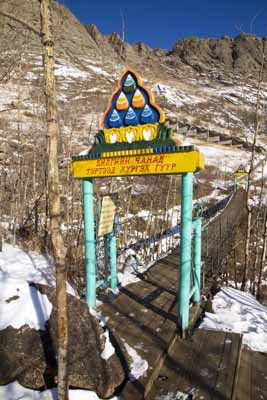
Bridge leading to the Aryaval Temple


Bridge leading to Aryaval Temple. The sign says, “The Bridge to Deliver You Beyond Wisdom.”


Aryaval Khiid

The new rock carvings by Bayantsagaan on the cliffs above the temple turned out to be mostly covred with snow, so I could not get good photos.


The four new stone carvings by Bayantsagaan can barely be made out in this photo


Three of the stone carvings can be seen here


A slightly better view of one of the stone carvings


These carvings—the Power of Ten Symbol and the Om Mani Padme Hum mantra have been here for awhile, but have recently been painted.

As soon as the snow is gone—either blown off or melted—I will return to Aryaval and get better photos of the new carvings. But don’t hold your breath.


Tuesday, December 6, 2011

Uzbekistan | Bukhara | Naqshbandi’s Tomb


Baha-ud-Din Naqband  Bukhari, right


Today, the 10th of December according to the increasing irrelevant Gregorian calendar, is the 14th day of the month of Muharram, according to the Islamic Lunar Calendar. (It is also the day of the Full Moon, an auspicious day according to the Mongolian Lunar Calendar.) As most of you probably know, this is the birthday of Baha-ud-Din Naqshband Bukhari (1318–1389), the founder of what would become the Naqshbandi sect of Sufis. During a recent sojourn in Uzbekistan I wandered by his tomb, located in the village Kasri Arifon eight or so miles from Bukhara


Entrance to the Mausoleum of Baqshbandi


Tomb of Baqshbandi


Tomb of Baqshbandi


Tomb of Baqshbandi


Monument in the Mausoleum Complex


Uzbekistan Roses in all their resplendent glory just outside the Mausoleum Complex

Uzbekistan | Bukhara | Naqshbandi’s Tomb

Baha-ud-Din Naqband  Bukhari, right
Today, the 10th of December according to the increasing irrelevant Gregorian calendar, is the 14th day of the month of Muharram, according to the Islamic Lunar Calendar. (It is also the day of the Full Moon, an auspicious day according to the Mongolian Lunar Calendar.) As most of you probably know, this is the birthday of Baha-ud-Din Naqshband Bukhari (1318–1389), the founder of what would become the Naqshbandi sect of Sufis. During a recent sojourn in Uzbekistan I wandered by his tomb, located in the village Kasri Arifon eight or so miles from Bukhara
Entrance to the Mausoleum of Baqshbandi
Tomb of Baqshbandi
Tomb of Baqshbandi
Tomb of Baqshbandi
Monument in the Mausoleum Complex
Uzbekistan Roses in all their resplendent glory just outside the Mausoleum Complex

Saturday, December 3, 2011

Chingis Khan Rides West | Flight of the Khorezmshah | Balkh | Nishapur


When we last left Chingis Khan he was At the Walls of Samarkand. Before addressing the siege of Samarkand, however, we should examine the flight of Khorezmshah. 


Chingis Khan may have hurried on to Sarmarkand in the hopes of finding the Khorezmshah himself in the city. After all, since 1212 Samarkand had been the de facto capital of the Khorezm Empire, and when the Mongol threat had first loomed on the horizon the Khorezmshah had personally overseen the  repair and upgrading of the city’s fortifications. He had also stationed a considerable portion of his armies in Samarkand, and Chingis might well have expected him to remain in the city and take personal command of his troops.  If so, the Mongol khan was disappointed. Upon arriving at the walls of Sarmarkand he immediately received intelligence that not only was the Khorezmshah not in Sarmarkand, but that he fled Mawarannahr altogether. According to Juvaini: 


 . . . the Sultan withdrew from the conflict, the control of firmness having slipped from his hands and the attraction of constancy having been replaced by flight; while perplexity and doubt had taken abode in his nature; he deputized the protection of most of his lands and territories to his generals and allies.


He had crossed the Amu Darya River into Khorasan “in a state of terror and bewilderment,” according to Juvaini, near the city of Termez and was now holed up in the vicinity of Balkh, in what is now Afghanistan.  He professed that he had left Mawarannahr to rally his troops who were stationed in Khorasan for a final showdown with the Mongols, but to many in the cities north of the Amu Darya it must have appeared that their Sultan had abandoned them altogether. Chingis Khan, perhaps remembering How Khüchüleg Had Escaped from his grasp and had remained as a thorn in is side for years afterward, now declared, “It is necessary to make an end to him and be well rid of him before men gather around him and nobles join him from every side.” Chingis would remain behind to invest Samarkand, but he immediately dispatched two of his best generals, Jebe and Sübetei,  in pursuit of the errant Khorezmshah. Jebe had of course already earned his stripes by Hounding Down and Killing Khüchüleg in the High Pamirs. Sübetei was an up-and-coming commander who would eventually distinguish himself in campaigns in China, Hungary, and elsewhere and become one of Chingis Khan’s most illustrious generals. Under their command were 30,000 troops, “each of whom was to a thousand men of the Sultan’s army as a wolf to a flock of sheep,” according to the ever-gushing Juvaini.


From Samarkand the Mongol pursuit party rode south 190 miles to the Amu Darya and crossed the river at the well-known Mela Ford, near the town of Panjab sixty miles east of Termez and close to the mouth of the Vakhsh River. The river here currently serves as the boundary between Tajikistan and Afghanistan. Ibn al-Athir described the manner of the crossing: 


They [the Mongols] made out of wood something like a large water-trough, covered them with ox-hides, in order that they should be water-tight, placed their weapons and utensils in them, led their horses into the water, grasped their tales (with their hands), having fastened these wooden troughs to themselves, so that the horse towed the man and the man towed the trough filled with weapons, etc., and thus everything crossed at the same time.”


Barthold questions this account, citing the scarcity of wood for making troughs along the Amu Darya, and suggests that the Mongols used the method of crossing rivers described by Plano Carpini in which the gear was placed in tightly bound leather bags and not wooden troughs. The men sat on these bags, which served as rafts, and were pulled across the river by their swimming horses.


From here it was about fifty miles as the crow flies southwest to Balkh. The Mongols  arrived at city only to find that the Khorezmshah had already fled westward even before they had crossed the river. The city fathers, who at this point had no beef with the Mongols, sent out a deputation to parley with Jebe and Sübetei. The spokesmen, in hopes that Jebe and Sübetei would leave them in peace, offered provisions for the Mongol army and a local guide to assist them in their pursuit of the Sultan. With their eye on their main objective, the Mongol generals led their men onward. Thus Balkh escaped unscathed from this first encounter with the Mongols. 


They came next to the city of Zava, the current-day city of Torbat-i-Haidari in Iran,  480 miles south-southwest of Balkh, where Jebe and Sübetei demanded more provender for their troops. Here the city fathers were less cooperative. They closed the city gates and refused to give any assistance to the Mongols. At this point apparently still under orders to track down and capture the Khorezmshah and not to invest cities, Jebe and Sübetei decided to bypass the city. But after they had left word reached them that the citizens of the city were celebrating what they perceived to be a victory by beating on drums and pouring out streams of abuse at the Mongols who were apparently afraid to attack their city. This proved be to be too much for Jebe and Sübetei. The reputation of the Mongols as an invincible force was at stake. They wheeled their army around and returned to put the city under siege. One the third day, according to Juvaini, “they scaled the walls and left not alive whomsoever they saw; and being unable to stay they burnt and broke whatever was too heavy to carry.”


No sooner had they sacked the city than an enormous earthquake, the worse in living memory, hit eastern Khorasan (the area is notorious for earthquakes; huge temblors have rocked the area as late as 1986 and 1997). Juvaini could not resist the conclusion that these two events were somehow connected: “It was as though this fighting and slaying were the clue to the calamities of Fate and the disaster of cruel Destiny . . . an earthquake shook Khorasan, and from hearing that event, whereof they had never heard the like, the people were seized with terror.” Jebe and Sübetei, however, were not to be delayed by mere earthquakes. They and their men hurried on east to the city of Nishapur, sixty-five miles northwest of Turbat-i-Haidari where according to the latest intelligence they had received the Khorezmshah was now holed up.


The Sultan had arrived in Nishapur from Balkh on April 18, 1220. If we are to believe Juvaini, he had by this time effectively abdicated all responsibility for his empire and had returned over the command of his armies to his son Jalal al-Din. For almost a month, until May 12, he instead gave himself over to bacchanalias:


Here he turned his back on the affairs of his realm, amusing himself with songstresses and songs . . . He therefore constantly applied himself to the quaffing of cups of wine and had no fear of the arrows of reproach . . . Because of arranging the jewels on his women he could not concern himself with the training of his men, and whilst pulling down the garments of his wives he neglected to remove the confusion in important affairs.


The Khorezmshah was approached by numerous of the town fathers and other important personages of the area who petitioned him on various matters of state and business—he was in their eyes, after all, still the Sultan of the Khorezm Empire—but all came away “perplexed and bewildered” by his dissolute behavior. Finally, having seen enough of their unwelcome guest, they assembled at the gate of the local vizier, Mujir-al-Mulk, and protested against the unseemly behavior of the Sultan. Mujir-al-Mulk, although a highly respected official, admitted that there was not much he could do:


What you say is perfectly true, and your complaints are fully justified . . . Because of my duties as a pander [qavvadagi, or pimp], I cannot attend to the business of leaders . . . and because I must see to the provision of damsels I have no time to check the registers. Some days ago the Sultan commanded us to provide so and so many ornaments for the singing girls and to do nothing else. The Sultan‘s orders must be complied with . . .


It was at this moment, according to Juvaini, that news arrived in Nishapur that Jebe and Sübetei and 30,000 Mongols had crossed the Amu Darya into Khorasan and now like the very hounds of hell were hot on the trail of the Khorezmshah.  The Sultan had indulged in the belief that regardless of what happened to his realm in Mawarannahr he was safe here in Khorasan. Now he was exposed to the harsh light of reality. ‘Having drunk every drop in the goblet of pleasure he ought to have expected the sting of the headache that followed,” pontificated Juvaini, adding “And for every joy there was substituted a sorrow and for every rose was exchanged a thorn.” Alerted to the imminent arrival of the Mongols in Nishapur, the Khorezmshah absconded from the city on May 12, 1220, according to Juvaini.


While Juvaini’s account of the Khorezmshah’s titillatingly scandalous behavoir in Nishapur is certainly entertaining, it must be mentioned that Nasavi, who as the secretary of Jalal al-Din, the Sultan’s son, should have been well-informed on the Sultan’s movements, implies that the latter in his haste to escape the Mongols passed right through Nishapur without even stopping for a day.It is possible, however, that Nasavi did not want to dwell on the reprehensible behavior of the Khorezmshah, the father of his patron, while in Nishapur, and choose instead to simply ignore this interlude.


The Flight of the Khorezmshah (See Enlargement)