Thursday, April 9, 2026

USA | Allegheny Mountains | Ramps

Ramps Season has begun! For many foragers ramps (Allium tricoccum) are the Holy Grail of edible plants. I located a dozen or more small colonies of ramps along a small tributary of the Casselman River.

Tributary of the Casselman River (click on photos for enlargements)

A nice colony of ramps next to a convenient brooklet for washing them.

A small colony of ramps

Another colony of ramps

Ramps

Ramps

Most ramp plants have two leaves. One leaf can be harvested from a plant without killing it.

The whole ramp plant. Authorities recommend harvesting no more than 10% of a colony to ensure its long-term health. I never harvest more than 5%. The leaves and bulbs can be used in any way you would use onions.

Iran | Yazd

Wandered by Yazd, a city of about one million people located near the middle of Iran. It is known as one of the hottest cities in the country. As with many cities in the desert water is held in high regard. 
 Main square of Yazd (click on photos for enlargements)
 Main square of Yazd
 Main square of Yazd
Kids playing in the main square of Yazd. The city’s famous wind-catchers, which catch cool breezes and funnel them down into the buildings below, can be seen in the background. The wind-catchers were an early form of air-conditioning. 
 Skyline of Yazd with more wind-catchers
Wind-Catchers
Streets of Yazd
 Mosque in Yazd
 Detail of mosque in Yazd
  Detail of mosque in Yazd
 Hotel where I stayed in Yazd
 Courtyard of hotel where I stayed in Yazd
  Courtyard of hotel where I stayed in Yazd
Courtyard of hotel where I stayed in Yazd. The perfect place for sipping a saffron tisane as the air cools off at twilight. 

Tuesday, March 31, 2026

Iran | Esfahan | Abbasi Hotel

Wandered down to Esfahan, south of Tehran. I was especially looking forward to visiting Esfahan since I had booked a room at the legendary Abassi Hotel, which if not the city’s best hotel is certainly the most historic and picturesque.
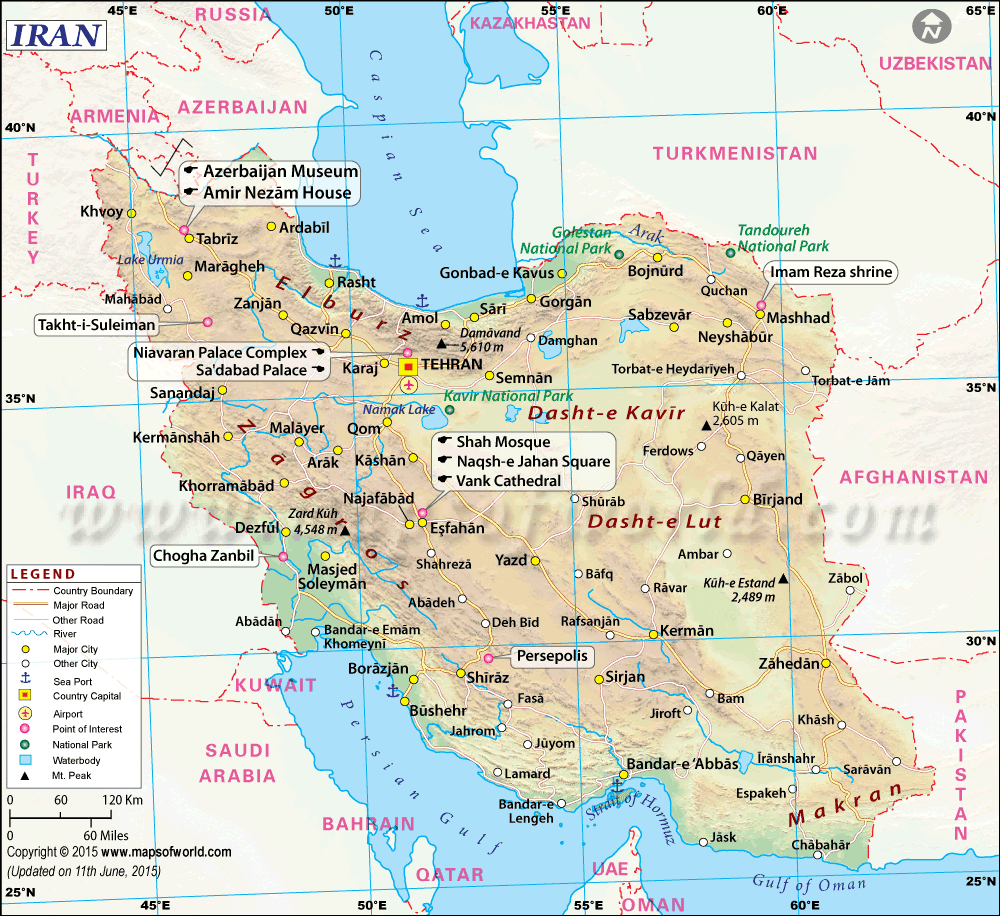
Location of Esfahan (click on photos for enlargements).
The Abbasi Hotel was originally a caravanserai built during the time the the Safavid Sultan Husayn (1668—1726). It was restored and remodeled in the 1950s into an upscale hotel. Film buffs may recognize the hotel as the set for the 1974 movie Ten Little Indians starring Oliver Reed and German bombshell Elke Sommer. I had read some on-line reviews that groused about the small size of some of the rooms at the hotel. This was certainly not the case with my first floor room, which opened directly onto the courtyard. A troop of dancers, had one been available, could have bivouacked in the room with space left over for a camel or two. 
This etching was made in 1840. 
The basic layout of the building itself has changed very little since 1840. The two-story arched alcove near the right edge of the etching now hosts a charming little snack shop. The dome and minaret of the mosque seen looming over the top of the building are unchanged. Oh how I would have loved to have been in that courtyard when it still hosted camels! Note that the camels shown are Two-Humped Bactrians, the most noble of the world’s four-legged creatures, and not one-humped dromedaries. I would have had second thoughts about staying at the caravanserai if they had allowed in dromedaries, unless, of course, dromedaries were restricted to their own watering troughs.

Camels (Bactrian). You can’t help but love them.

Lobby of hotel. I took this photo at five o’clock in the morning. During the day and evening the lobby was a madhouse of milling tourists from England, Germany, Italy, Spain, China, and elsewhere. As far as I could tell I was the only American. 
Courtyard of hotel
Courtyard of hotel
Courtyard of hotel
Courtyard of hotel
Courtyard of hotel
Courtyard of hotel
Courtyard of hotel
I spent my late afternoons in the courtyard enjoying glasses of refreshing hibiscus tisane with rock sugar. Clinically proven to lower your blood pressure!
Hotel lobby coffee shop where I got my morning caffeine fix. In the afternoons it was jammed with Chinese tour groups.

Thursday, March 12, 2026

USA | Allegheny Mountains | Wanders on the Great Allegheny Passage (GAP) | Flora | Coltsfoot

Biked from Meyersdale south to the Big Savage Tunnel. Still no word from the GAP panjandrums on when the tunnel will open. When I arrived at the rest stop a guy in his mid-twenties was just packing up his camping gear. He had spent the night at the rest stop. He wanted to continue south on the GAP and asked if I knew any detours around the tunnel. Actually I do. At Mile Post 23, less than half a mile from the rest stop, a steep road turns off to the right, if you are coming from the tunnel, and drops down to Shirley Hollow Road. This road crosses Laurel Run—a beautiful little babbling brook at this point—and proceeds another 2.2 miles (up 240 vertical feet) to the tiny hamlet of Pleasant Union on Route 160. Truly determined GAPers can take this route to travel from Pittsburgh or points east to Cumberland when the Big Savage Tunnel is closed. (For more on the detour see my Wanders on the Great Allegheny Passage: Frostburg to Garrett.) At the intersection of Route 160 and Shirley Hollow Road turn right. After .65 of a mile the road drops down the side of Big Savage Mountain 3.7 miles to the Mason-Dixon Line (1,282 vertical feet) at the village of Wellersburg. The famous surveyors Mason and Dixon camped near here in June of 1766, the furthest point west they surveyed that year. They would return the next year and continue the survey of the Maryland-Pennsylvania border westward.

In Maryland the road, now Maryland Route 47, continues another 1.7 miles to Barrelville, on Route 36, the Mount Savage Road, with a drop of another 200 vertical feet. Turn right here and proceed .6 of a mile to Woodcock Hollow Road. It’s another 1.6 of a mile up the road, with a vertical altitude gain of 303 feet, to the GAP at the Woodcock Hollow Road Crossing. From here you can proceed on the GAP to either Frostburg or Cumberland. Doing this trip in reverse, with the 5.6-mile climb up Big Savage Mountain from Barrelville to the Shirley Hollow Road cutoff, with a vertical altitude gain of 1516 feet, is certainly doable on electric bikes (I did it), but it would test the endurance of Olympian athletes on regular bikes. If you are traveling south and are hell-bent on getting to Cumberland as fast as possible this detour is 3.85 miles shorter than the GAP between the same two points (Shirley Hollow Road cutoff and the Woodcock Hollow Crossroads), eliminating as it does the big loop around Frostburg, You can also make excellent time flying down off Big Savage Mountain, your speed limited only by how fast you dare to go.

I told the young man it was possible to this but that I was not necessarily recommending that he try. This is fairly easy ride on electric bikes but the climb from Laurel Run up to Route 160 might be difficult for someone on a regular bike. Also, I did not know the current condition of Shirley Hollow Road, which is unpaved. It might still be muddy and difficult to navigate. The guy said he was going to try it, however. I hope he got through.

I walked up upstream on Laurel Run, the stream the GAP crosses just north of the tunnel. I was looking for golden saxifrage, blood root, and various trilliums, all among the first plants to appear in the Spring. I found nothing in bloom. Jack-in-the-Pulpits also occur here, although not of course until the end of spring and the beginning of Summer.

Laurel Run
I rode back towards Meyersdale and was startled to see just before the Continental Divide several clumps of coltsfoot. I had scanned the right-of-way of the GAP very carefully riding south and they were not here when I passed by three hours earlier.

Coltsfoot

Coltsfoot

Coltsfoot

Coltsfoot

Coltsfoot
These are the first flowers I have seen in bloom the GAP this year. Riding on I saw numerous clumps of coltsfoot the whole way to Meyersdale. None had been in bloom that morning. They had appeared in the space of three hours.

Monday, March 9, 2026

USA | Great Allegheny Passage (GAP) | Spring Flora and Fauna

Rode from Meyersdale westward on the GAP to Rockwood and then rode back to Meyersdale and continued south to Big Savage Tunnel. Still no word from the GAP panjandrums on when the tunnel will be opened for the year. Anyhow, the trail is totally snow and ice-free from the Big Savage Tunnel to Rockwood. Saw the first robin of the year back on March 1—oddly enough the same date I saw the first robin last year—and have been seeing more and more of them every day. For my love affair with robins see Wanders on the Great Allegheny Passage: Frostburg to Garrett.
Also saw half a dozen wedges of Canadian geese winging it north for the season. A few took a break on a frozen pond just north the Sand Patch Crossroads.
Canadian Honkers
I also stopped to collect bark from the yellow birch trees south of Sand Patch. I got a whole garbage bag full. There is nothing better for starting campfires.
Yellow Birch

Not much vegetation yet, but I did see the young leaves of dandelion
Dandelion
Also the early leaves of ox-eyed daisies. 
 Early leaves of Ox-Eyed Daisies

Wednesday, March 4, 2026

Iran | Tabriz | Covered Bazaar | Tea

Wandered by Tabriz, a city of some 1.7 million souls—the fifth largest city in Iran. In 1655 the legendary Turkish gadabout Evliya Çelebi ((1611–1682; his mammoth Book of Travels—ten volumes, only eight have survived—is what his translator calls “probably the longest and most ambitious travel account by any writer in any language.”) spent two months in Tabriz and observed:

. . . in the entire kingdom of Persia there is no city and no countryside as fine as Tabriz, the ravisher of hearts . . . It is a large and ancient city with delightful climate, lovely boys and girls, lofty buildings and numerous foundations and institutions. May God allow that it will once again belong to the Ottomans [the Ottoman Turks had occupied Tabriz from 1585 to 1603] . . . may God Most High cause it to flourish forever!

Hotel in Tabriz where I stayed (click on photos for enlargements)

View of Tabriz from my hotel room

While in the city I visited the famous Tabriz Bazaar, said to be the largest covered bazaar in the world. It covers 66.7 acres, with 3.41 miles of passageways and 5500 shops. The Grand Bazaar of Istanbul, while ranking as the biggest single tourist attraction in the world, with over 91,000,000 visitors a year, has between three and four thousand shops. The largest mall in the United States, the Mall of America in Bloomington, Minnesota covers more space than the Tabriz Bazaar—96.4 acres total with 56.8 acres devoted to 530-some shops—but many would argue that it is not a covered bazaar in the classic sense of the term but rather a New World mutation.

Gallery in the Tabriz Bazaar

Of course I gravitated to the tea shops. Here tea is sold by the kilo out of big wooden bins, as God intended, not in ridiculous little tea bags.

Tea for sale in the Tabriz Bazaar


 Green tea (Chai Sabz) grown in Lahijan, a city in Gilan Province in northern Iran, just south of the Caspian Sea). The sign indicates that this tea is Chin Bahara (spring pick). I like that they say when the tea is picked. Freshness is crucial with green tea.