Saturday, August 8, 2015

Uzbekistan | Bukhara | Kosh Madrassas


The Kosh Madrassas (kosh = twin, pair, double, etc.) are not identical, but they do face each other across a square.


Ubdullah Khan Madrassa, left center, and Modari Madrassa, right center (click on photos for enlargements)


Both were built by Abdullah Khan II, the last Shaybanid Dynasty Khan of Bukhara (r. 1583–1598)


Abdullah Khan II 


The Modari  (mother,  in Persian) Madrassa was built in 1566 in honor of Abdullah Khan’s mother.


 Another view of the Modari Madrassa


Interior of the Modari Madrassa


The  Abdullah Khan Madrassa, facing the Modari Madrassa, was built by Abdullah Khan in the years 1588-90.


 Abdullah Khan Madrassa


 Courtyard of  Abdullah Khan Madrassa


 Ceiling of Abdullah Khan Madrassa

Uzbekistan | Bukhara | Kosh Madrassas

The Kosh Madrassas (kosh = twin, pair, double, etc.) are not identical, but they do face each other across a square.
Ubdullah Khan Madrassa, left center, and Modari Madrassa, right center (click on photos for enlargements)
Both were built by Abdullah Khan II, the last Shaybanid Dynasty Khan of Bukhara (r. 1583–1598)
Abdullah Khan II 
The Modari  (mother,  in Persian) Madrassa was built in 1566 in honor of Abdullah Khan’s mother.
 Another view of the Modari Madrassa
Interior of the Modari Madrassa
The  Abdullah Khan Madrassa, facing the Modari Madrassa, was built by Abdullah Khan in the years 1588-90.
 Abdullah Khan Madrassa
 Courtyard of  Abdullah Khan Madrassa
 Ceiling of Abdullah Khan Madrassa

Friday, August 7, 2015

Mongolia | Khövsgöl Aimag | Darkhad Depression #5


We head down the left bank of the Buural Gol through thick taiga to its confluence with the Ulaan Ongo Gol. The source of the Ulaan Ongo, seven or eight miles upstream from here, is only about a mile and a half from the source of the Khoogiin Gol, where we are headed, but Batmönkh says the head of the Ulaan Ongo Gol dead ends in impassable cliffs, making it impossible to reach the Khoogiin Gol from there. Instead we will head farther down the Buural and follow a small tributary of the Buural to a pass leading to the Khoogiin. The trail meanders through thick stands of willows and larch. At places the Buural Gol flows under ten-foot thick-football field-sized slabs of ice which Batmönkh says never melt during the summer.


Soon we come to the small unnamed tributary tumbling down a deep ravine to the left. We turn off and follow a vague trail up the right side of the ravine up through a thick larch forest. The misting rain slowly builds into a steady shower. Up ahead, through the mists and clouds, we can make out the snow already falling on the pass.


The trail gets steeper and steeper and we have to make many detours around fallen timber. On one particularly steep section Batmönkh, who is riding right behind me, shouts, “your girth strap has come loose.” He no sooner says this than my horse lunges upward over the steep trail. I feel the saddle sliding beneath me and I topple off the right side of the horse. The horse, with the saddle dangling underneath its belly by the front strap, goes berserk, bucking like a rodeo bronco. Hanging onto the lead rope I am dragging a couple of yards before the horse makes a final lunge and jerks the rope out of my hand. The horse promptly starts trotting back down the trail the way we come. Bayarkhüü rides off in hot pursuit. This is not good. After running off like this horses are notoriously hard to catch again, and especially by one person, like Bayarkhüü, on the thickly-forested side of a ravine. Batmönkh finds the saddle and inspecting it discovers that the girth strap had broken off where it attaches to the saddle. It is not clear, however, if this happened before or after the saddle came off.


After a half an hour Bayarkhüü appears with my horse in tow. My opinion of his horse-handling skills, already high, soars. Batmönkh jerry-rigs the strap back onto the saddle with a scrap of rope—some essential part, I can’t make out what, is missing—and soon we are back on the trail. Another half hour later we emerge from the taiga onto the tundra leading to the pass.


On the tundra below the pass (click on photos for enlargements)


Looking back the way we came


As we approach 8356-foot Khushit Khem Pass it starts snowing in earnest, big wet flakes which quickly soak through the deels of the horsemen, who have no rain gear. They hurry on across the pass. I linger behind with Nergui, who has no raingear either, but seems oblivious to the snow.


Nergui at 8356-foot Khushit Khem Pass. This is in the middle of June.


Mongolia | Khövsgöl Aimag | Darkhad Depression #5

We head down the left bank of the Buural Gol through thick taiga to its confluence with the Ulaan Ongo Gol. The source of the Ulaan Ongo, seven or eight miles upstream from here, is only about a mile and a half from the source of the Khoogiin Gol, where we are headed, but Batmönkh says the head of the Ulaan Ongo Gol dead ends in impassable cliffs, making it impossible to reach the Khoogiin Gol from there. Instead we will head farther down the Buural and follow a small tributary of the Buural to a pass leading to the Khoogiin. The trail meanders through thick stands of willows and larch. At places the Buural Gol flows under ten-foot thick-football field-sized slabs of ice which Batmönkh says never melt during the summer.

Soon we come to the small unnamed tributary tumbling down a deep ravine to the left. We turn off and follow a vague trail up the right side of the ravine up through a thick larch forest. The misting rain slowly builds into a steady shower. Up ahead, through the mists and clouds, we can make out the snow already falling on the pass.

The trail gets steeper and steeper and we have to make many detours around fallen timber. On one particularly steep section Batmönkh, who is riding right behind me, shouts, “your girth strap has come loose.” He no sooner says this than my horse lunges upward over the steep trail. I feel the saddle sliding beneath me and I topple off the right side of the horse. The horse, with the saddle dangling underneath its belly by the front strap, goes berserk, bucking like a rodeo bronco. Hanging onto the lead rope I am dragging a couple of yards before the horse makes a final lunge and jerks the rope out of my hand. The horse promptly starts trotting back down the trail the way we come. Bayarkhüü rides off in hot pursuit. This is not good. After running off like this horses are notoriously hard to catch again, and especially by one person, like Bayarkhüü, on the thickly-forested side of a ravine. Batmönkh finds the saddle and inspecting it discovers that the girth strap had broken off where it attaches to the saddle. It is not clear, however, if this happened before or after the saddle came off.

After a half an hour Bayarkhüü appears with my horse in tow. My opinion of his horse-handling skills, already high, soars. Batmönkh jerry-rigs the strap back onto the saddle with a scrap of rope—some essential part, I can’t make out what, is missing—and soon we are back on the trail. Another half hour later we emerge from the taiga onto the tundra leading to the pass.
On the tundra below the pass (click on photos for enlargements)
Looking back the way we came
As we approach 8356-foot Khushit Khem Pass it starts snowing in earnest, big wet flakes which quickly soak through the deels of the horsemen, who have no rain gear. They hurry on across the pass. I linger behind with Nergui, who has no raingear either, but seems oblivious to the snow.
Nergui at 8356-foot Khushit Khem Pass. This is in the middle of June.

Thursday, August 6, 2015

Mongolia | Zavkhan Aimag | Khoid Dayan Ovoo (Dayan Uul)


Wandered around Otgontenger Uul on a five-day circling of the mountain by horse. On the last day the sky was a perfect dome of cobalt blue from horizon to horizon—the first morning without rain we had experienced on the trip. After a leisurely breakfast we finally packed up and headed over the ridge to the west of Khökh Nuur. Climbing through a larch forest—the first trees we had encountered around Otgon Tenger—we finally arrived at Khoid Dayan Ovoo, or Dayan Uul, as some call it. From here there are spectacular views of the whole Otgontenger massif. Batbayar says this is one of the most sacred spots in Zavkhan Aimag and that many people come here to make offerings. He claims it was used by shamans even before the advent of Buddhism.


 Khoid Dayan Ovoo (click on photos for enlargements)


Khoid Dayan Ovoo


 Batbayar and Yooton prostrating at the Khoid Dayan Ovoo


  Otgontenger from the Khoid Dayan Ovoo


  Otgontenger from the Khoid Dayan Ovoo


Otgontenger from the Khoid Dayan Ovoo


Yooton


Mongolia | Zavkhan Aimag | Khoid Dayan Ovoo (Dayan Uul)

Wandered around Otgontenger Uul on a five-day circling of the mountain by horse. On the last day the sky was a perfect dome of cobalt blue from horizon to horizon—the first morning without rain we had experienced on the trip. After a leisurely breakfast we finally packed up and headed over the ridge to the west of Khökh Nuur. Climbing through a larch forest—the first trees we had encountered around Otgon Tenger—we finally arrived at Khoid Dayan Ovoo, or Dayan Uul, as some call it. From here there are spectacular views of the whole Otgontenger massif. Batbayar says this is one of the most sacred spots in Zavkhan Aimag and that many people come here to make offerings. He claims it was used by shamans even before the advent of Buddhism.
 Khoid Dayan Ovoo (click on photos for enlargements)
Khoid Dayan Ovoo
 Batbayar and Yooton prostrating at the Khoid Dayan Ovoo
  Otgontenger from the Khoid Dayan Ovoo
  Otgontenger from the Khoid Dayan Ovoo
Otgontenger from the Khoid Dayan Ovoo
Yooton

Wednesday, August 5, 2015

Mongolia | Khövsgöl Aimag | Source of the Yenisei River


I rose just as the last stars were fading from the sky. Only Jupiter still glowed brightly over the southwest horizon. I kindled the fire, brewed up a pot of Puerh Tea (eight year-old "Autumn Di Jie" brand puerh tea from Yunnan Province, China, with earthy hints of tobacco and chocolate), and sat on my carpet drinking tea as the sky shaded from pearly gray to azure, with not a cloud from horizon to horizon. Two hours later everyone was finally up and we discussed our plans for the day. Batmönkh said the source of the Mungaragiin Gol was just over a low pass to the southwest, where Jupiter had been shining in the morning. The route to our next destination, the source of the Khoogiin, however, was over the pass at the head of the valley we were in, to the northwest. He now suggested that Bayarkhüü and I ride to the source of the Mungaragiin ourselves while he and the others stayed in camp. When we returned we would break camp and cross the pass to the northwest. This way we would not have to backtrack with the pack horses. I agree to this. Yooton announces that she does not want to miss out on anything and will come along with Bayarkhüü and me. That’s fine with me.


Valley of the Mungaragiin, with Belchir Uul in the distance (click on photos for enlargements)


The low pass is only about a mile and a half away. To the left, down the valley of the Mungaragiin Gol, can be seen Mungaragiin Nuur (lake). At the valley, at its head, we get our first glimpse of 10,994-foot Belchir Uul, the highest peak of the mountains to the west of the Darkhad Depression. The source of the Mungaragiin Gol is right at the base of this mountain. Heading upstream, we ride by a small lake dotted with sea gulls. Had they come from the ocean? The Arctic Ocean is over 2000 miles away to the north. Further on is another small lake, this one still almost completely ice covered.


First Lake

We ride on another half mile to yet another small lake. According to my map, there are several small ponds still further on in the cirque directly below Belchir Uul, but there is no water flowing down the rocky ravine above the third lake we are on. The ponds apparently drain underground into this lake. Thus the outlet of the lake is, at least at this time of the year, the source of Mungaragiin Gol.


Horses at Second Lake 


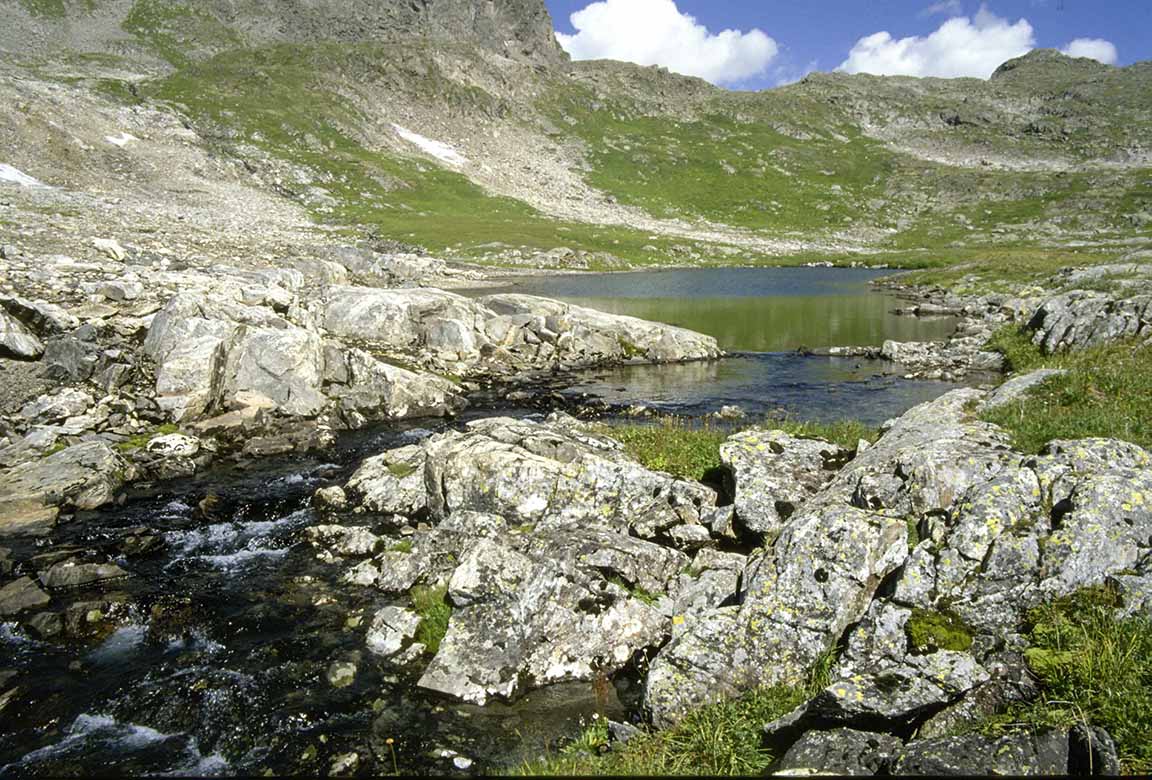
Source of the Mungaragiin Gol, and one of three sources of the Yenisei


10,994-foot Belchir Uul


The Mungaragiin Gol, I have determined, is one of sources of the Yenisei River System. The Mungaragiin flows west of here and combines with the Guna Gol to form the Bakhmakh Gol, which we had crossed on the way to Batmönkh’s Ger. According to most sources, including Batmönkh, the Bakhmakh combines with the Altgana Gol, flowing in from the mountains to the east of the Depression, to form the Shishigt Gol, which then flows into Tsagaan Nuur. Some say the river known as the Shishigt Gol begins not at confluence of the Bakhmakh and Altgana but at the outlet of the Tsagaan Nuur. In either case, the Shishigt Gol flows out of Tsagaan Nuur and continues west to the Russian border, where it combines with the Busiin Gol and the Bilin Gol to form the Kyzyl Khem. The Kyzyl Khem then continues west to the city of Kyzyl, capital of the autonomous repubic of Tuva, where it combines with the Biy Khem to form the Yenisei proper. The National Geographic Atlas of the World lists both the Biy Khem and the Kyzyl Khem-Shishigt as the two sources of the main branch of the Yenisei (zoom in on the Lake Khövsgöl area of the map).


In 1993 I had hiked some sixty miles to the source of the Biy Khem in the extremely remote East Sayan Mountains in the Autonomous Republic of Tuva. A geographer at the Russian Academy Sciences in Irkutsk, in Siberia, where I was living at the time, had opined to me that this was the real source of the main branch of river known as the Yenisei, since the Biy Khem is bigger than the Kyzyl Khem in terms of volume of water where the two come together. But he allowed that the actual drainage area of the Kyzyl Khem system was larger than that of the Biy Khem so it too had a claim to be the source of the Yenisei. It should be pointed out that there is no scientific definition of the source of a river system, and almost any finding is open to interpretation; hence the long running dispute over the source of the Nile, for example, which ended up with One Of The Disputants getting so frustrated he allegedly committed suicide.


Source of the Yenisei-Biy Khem in the East Sayan Mountains, in the Autonomous Republic of Tuva


In any case, it would appear that the outlet of the lake where we are now standing is at least one of the sources of the Yenisei. The location is N50º51.382' / E098.41.223' and the altitude is 7,802 feet. One atlas (no two agree) states the Yenisei branch of the Yenisei River System is 2537 miles long, although it neglects to mention which source it is using as the beginning of the river.


But the hydrology of the Yenisei River System is extremely complicated. Where the westward flowing Angara River, the big, fast-flowing river that runs out of Lake Baikal in Siberia, and the northward flowing Yenisei branch of the river system combine, the Angara is almost twice as big in terms of water volume. Thus by some definitions the ultimate source of the Yenisei River System would be at the beginning of the Angara branch of the system. The largest river flowing into Baikal is the Selenga (Selenge, in Mongolia). The Selenge, in turn, starts at the confluence of the Delger Mörön and Ider rivers in Mongolia. Since the Ider is bigger in terms of water volume its source would be the beginning the Yenisei-Angara-Selenge branch of the Yenisei River System. The Times [of London] World Atlas considers the Yenisei-Angara-Selenge the main branch of the river system and gives its length as 3448 miles, considerably longer than the Yenisei-Biy Khem branch. And it is not clear if the 281 mile-long Ider is included in this measurement. If not then this branch would measure 3729 miles long. This would be in line with the figure of 3742 miles given to me by the geographer in Irkutsk for the Yenisei-Angara-Selenge-Ider. In either case, it would rank as either the fifth or sixth longest river in the world, depending on which atlas we consult. In terms of water volume it is the Largest North-Flowing River in the world. In 1997 I visited Zavkhan Aimag and rode three days by horse to the source of the Ider, which I located near 11,873-foot Öndör Ölziit Uul, at an elevation of 9,880 feet, as described in my book Wanders in Northern Mongolia.


Source of the Yenisei-Angara-Selenge-Ider Gol in Khangai Mountains, Zavkhan Aimag


Another view of the source of the Yenisei-Angara-Selenge-Ider Gol


As we sit by the outlet of the lake, the source of the Mungaragiin Gol, I explain all this to Yooton, who sweet girl that she is listens patiently and nods knowingly every so often to indicate that she is paying attention. I suspect she does not have the slightest interest in what I am talking about. Not everyone shares my fascination with the sources of rivers. Finally it is time to leave. Two hours later we are back in camp where Nergui has a kettle of Yunnan Gold and dinner ready for us. Now I have now been to all three sources of the Yenisei River.


Three sources of the Yenisei River (base map courtesy of The Encyclopedia of Earth)


Mongolia | Khövsgöl Aimag | Source of the Yenisei River

I rose just as the last stars were fading from the sky. Only Jupiter still glowed brightly over the southwest horizon. I kindled the fire, brewed up a pot of Puerh Tea (eight year-old "Autumn Di Jie" brand puerh tea from Yunnan Province, China, with earthy hints of tobacco and chocolate), and sat on my carpet drinking tea as the sky shaded from pearly gray to azure, with not a cloud from horizon to horizon. Two hours later everyone was finally up and we discussed our plans for the day. Batmönkh said the source of the Mungaragiin Gol was just over a low pass to the southwest, where Jupiter had been shining in the morning. The route to our next destination, the source of the Khoogiin, however, was over the pass at the head of the valley we were in, to the northwest. He now suggested that Bayarkhüü and I ride to the source of the Mungaragiin ourselves while he and the others stayed in camp. When we returned we would break camp and cross the pass to the northwest. This way we would not have to backtrack with the pack horses. I agree to this. Yooton announces that she does not want to miss out on anything and will come along with Bayarkhüü and me. That’s fine with me.
Valley of the Mungaragiin, with Belchir Uul in the distance (click on photos for enlargements)
The low pass is only about a mile and a half away. To the left, down the valley of the Mungaragiin Gol, can be seen Mungaragiin Nuur (lake). At the valley, at its head, we get our first glimpse of 10,994-foot Belchir Uul, the highest peak of the mountains to the west of the Darkhad Depression. The source of the Mungaragiin Gol is right at the base of this mountain. Heading upstream, we ride by a small lake dotted with sea gulls. Had they come from the ocean? The Arctic Ocean is over 2000 miles away to the north. Further on is another small lake, this one still almost completely ice covered.
First Lake
We ride on another half mile to yet another small lake. According to my map, there are several small ponds still further on in the cirque directly below Belchir Uul, but there is no water flowing down the rocky ravine above the third lake we are on. The ponds apparently drain underground into this lake. Thus the outlet of the lake is, at least at this time of the year, the source of Mungaragiin Gol.
Horses at Second Lake 
Source of the Mungaragiin Gol, and one of three sources of the Yenisei
10,994-foot Belchir Uul
The Mungaragiin Gol, I have determined, is one of sources of the Yenisei River System. The Mungaragiin flows west of here and combines with the Guna Gol to form the Bakhmakh Gol, which we had crossed on the way to Batmönkh’s Ger. According to most sources, including Batmönkh, the Bakhmakh combines with the Altgana Gol, flowing in from the mountains to the east of the Depression, to form the Shishigt Gol, which then flows into Tsagaan Nuur. Some say the river known as the Shishigt Gol begins not at confluence of the Bakhmakh and Altgana but at the outlet of the Tsagaan Nuur. In either case, the Shishigt Gol flows out of Tsagaan Nuur and continues west to the Russian border, where it combines with the Busiin Gol and the Bilin Gol to form the Kyzyl Khem. The Kyzyl Khem then continues west to the city of Kyzyl, capital of the autonomous repubic of Tuva, where it combines with the Biy Khem to form the Yenisei proper. The National Geographic Atlas of the World lists both the Biy Khem and the Kyzyl Khem-Shishigt as the two sources of the main branch of the Yenisei (zoom in on the Lake Khövsgöl area of the map).

In 1993 I had hiked some sixty miles to the source of the Biy Khem in the extremely remote East Sayan Mountains in the Autonomous Republic of Tuva. A geographer at the Russian Academy Sciences in Irkutsk, in Siberia, where I was living at the time, had opined to me that this was the real source of the main branch of river known as the Yenisei, since the Biy Khem is bigger than the Kyzyl Khem in terms of volume of water where the two come together. But he allowed that the actual drainage area of the Kyzyl Khem system was larger than that of the Biy Khem so it too had a claim to be the source of the Yenisei. It should be pointed out that there is no scientific definition of the source of a river system, and almost any finding is open to interpretation; hence the long running dispute over the source of the Nile, for example, which ended up with One Of The Disputants getting so frustrated he allegedly committed suicide.
Source of the Yenisei-Biy Khem in the East Sayan Mountains, in the Autonomous Republic of Tuva
In any case, it would appear that the outlet of the lake where we are now standing is at least one of the sources of the Yenisei. The location is N50º51.382' / E098.41.223' and the altitude is 7,802 feet. One atlas (no two agree) states the Yenisei branch of the Yenisei River System is 2537 miles long, although it neglects to mention which source it is using as the beginning of the river.

But the hydrology of the Yenisei River System is extremely complicated. Where the westward flowing Angara River, the big, fast-flowing river that runs out of Lake Baikal in Siberia, and the northward flowing Yenisei branch of the river system combine, the Angara is almost twice as big in terms of water volume. Thus by some definitions the ultimate source of the Yenisei River System would be at the beginning of the Angara branch of the system. The largest river flowing into Baikal is the Selenga (Selenge, in Mongolia). The Selenge, in turn, starts at the confluence of the Delger Mörön and Ider rivers in Mongolia. Since the Ider is bigger in terms of water volume its source would be the beginning the Yenisei-Angara-Selenge branch of the Yenisei River System. The Times [of London] World Atlas considers the Yenisei-Angara-Selenge the main branch of the river system and gives its length as 3448 miles, considerably longer than the Yenisei-Biy Khem branch. And it is not clear if the 281 mile-long Ider is included in this measurement. If not then this branch would measure 3729 miles long. This would be in line with the figure of 3742 miles given to me by the geographer in Irkutsk for the Yenisei-Angara-Selenge-Ider. In either case, it would rank as either the fifth or sixth longest river in the world, depending on which atlas we consult. In terms of water volume it is the Largest North-Flowing River in the world. In 1997 I visited Zavkhan Aimag and rode three days by horse to the source of the Ider, which I located near 11,873-foot Öndör Ölziit Uul, at an elevation of 9,880 feet, as described in my book Wanders in Northern Mongolia.
Source of the Yenisei-Angara-Selenge-Ider Gol in Khangai Mountains, Zavkhan Aimag
Another view of the source of the Yenisei-Angara-Selenge-Ider Gol
As we sit by the outlet of the lake, the source of the Mungaragiin Gol, I explain all this to Yooton, who sweet girl that she is listens patiently and nods knowingly every so often to indicate that she is paying attention. I suspect she does not have the slightest interest in what I am talking about. Not everyone shares my fascination with the sources of rivers. Finally it is time to leave. Two hours later we are back in camp where Nergui has a kettle of Yunnan Gold and dinner ready for us. Now I have now been to all three sources of the Yenisei River.
Three sources of the Yenisei River (base map courtesy of The Encyclopedia of Earth)