See all seven World Wide Wanders.
Thursday, August 29, 2024


Tuesday, July 2, 2024
Uzbekistan | Seven Saints of Bukhara

According to the thirteen-century Persian historian Ata-Malik Juvaini, Bukhara, the city in what is now the country of Uzbekistan, “is the cupola of Islam and is in those regions like unto the City of Peace [Baghdad] . . . Since ancient times it has in every age been the place of assembly of the great savants of every religion.”
In the twelfth, thirteenth and fourteenth centuries seven remarkable men lived in Bukhara and the surrounding Bukhara Oasis. These men were known as the Khwajagan, or Masters of Wisdom. The Seven Khwajagan are: Abd al-Khaliq al-Ghujdawani (1103–1179); Arif ar-Riwakri (1136-1239); Mahmud al-Injir al-Faghnawi (d.1317);Ali ar-Ramitani (d.1315/1321); Muhammad Baba as-Sammasi (d.1354); Sayyid Amir Kulal (1287?–d.1370); Bahauddin Shah Naqshband (1318–1388?)
The Khwajagan remain to this day revered as the Seven Saints of Bukhara, and their mausoleum complexes continue to be visited by pilgrims and travelers from all over the world.

Tuesday, March 5, 2024
Italy | Venice | Early Life of Enrico Dandolo
There are few greater ironies in History than the fact that the fate of Eastern Christendom should have been sealed—and half of Europe condemned to some five hundred years of Muslim rule—by men who fought under the banner of the Cross. Those men were transported, inspired, encouraged, and ultimately led by Enrico Dandolo in the name of the Venetian Republic; and, just as Venice derived the major advantage from the tragedy, so she and her magnificent old doge must accept the responsibility for the havoc that they have wrought on the world. —Byzantium: The Decline and Fall—John Julius Norwich
Venetian Doge Enrico Dandolo (c.1107–1205) was one of the leaders of the Fourth Crusade and the mastermind behind the Sack of Constantinople in 1204. The stated goal of the Fourth Crusade, initiated by Pope Alexander III and launched in 1202, was to recapture the holy city of Jerusalem, which had been seized by the Saladin, the Muslim sultan of Egypt, Syria, Yemen, and Palestine, on October 2, 1187, ending nearly of nearly nine decades of occupation by the Occidental Crusaders. By the time the Crusaders reached Constantinople, however, the Venetian continence, led by Enrico Dandolo, was more concerned with collecting the money they claimed was owned to them by Byzantine Emperor Alexios IV (r. August 1203 to January 1204). Relations between the Venetians and the Byzantines quickly deteriorated and outright war soon broke out. On April 3, 1204, the Crusaders attacked the heavily fortified city. Enrico Dandolo himself, probably ninety-seven years old at the time and almost completely blind, led a contingent of troops to the city’s sea walls. Constantinople fell to the Crusaders on April 13. Historian Speros Vryonis describes what happened next:
The Latin soldiery subjected the greatest city in Europe to an indescribable sack. For three days they murdered, raped, looted and destroyed on a scale which even the ancient Vandals and Goths would have found unbelievable. Constantinople had become a veritable museum of ancient and Byzantine art, an emporium of such incredible wealth that the Latins were astounded at the riches they found. Though the Venetians had an appreciation for the art which they discovered (they were themselves semi-Byzantines) and saved much of it, the French and others destroyed indiscriminately, halting to refresh themselves with wine, violation of nuns, and murder of Orthodox clerics. The Crusaders vented their hatred for the Greeks most spectacularly in the desecration of the greatest Church in Christendom. They smashed the silver iconostasis, the icons and the holy books of Hagia Sophia, and seated upon the patriarchal throne a whore who sang coarse songs as they drank wine from the Church’s holy vessels . . . The defeat of Byzantium, already in a state of decline, accelerated political degeneration so that the Byzantines eventually became easy prey to the Turks. The Fourth Crusade and the crusading movement generally thus resulted, ultimately, in the victory of Islam, a result which was of course the exact opposite of its original intention.
Much of the loot seized by Enrico Dandolo and the Venetians during the sack of Constantinople can still be seen in Venice today, including, perhaps most notably, the Four Horses that once stood in the Hippodrome in Constantinople. They are now in the St. Mark’s Basilica Museum. Reproductions of the Horses grace the facade of the Basilica, mute reminders of Enrico Dandolo’s equivocal role in world history.
Wanders in Venice: The Early Life of Enrico Dandolo, Mastermind of the Fourth Crusade and the 1204 Sack of Constantinople traces the rise of the Dandolo Family to prominence in Venice and the life of Enrico Dandolo up until he was appointed Doge in 1192.

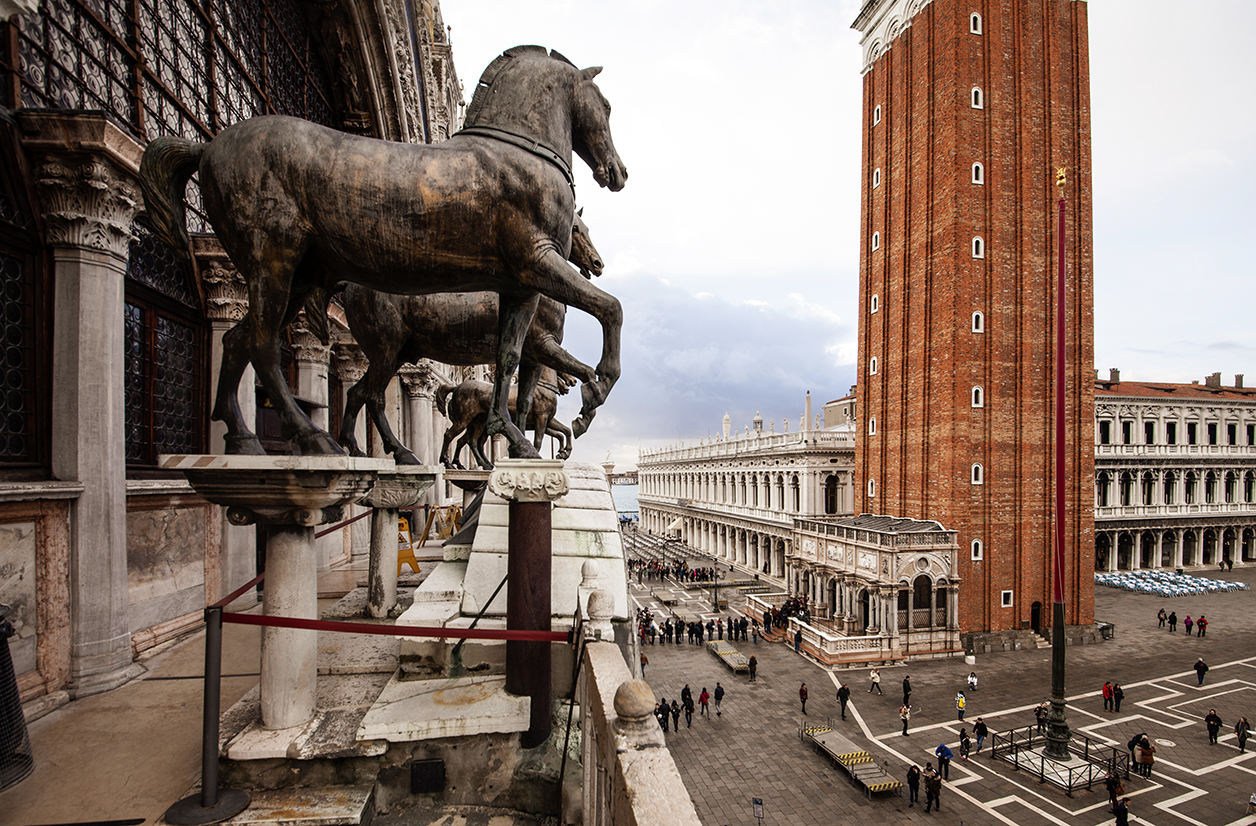 |
| Reproductions of The Four Horses that once stood in the Hippodrome in Constantinople. The originals are now in the St. Mark’s Basilica Museum. |
Monday, January 22, 2024
Mongolia | In Search of Shambhala: The 1925-1928 Roerich Expedition in Ulaanbaatar, Mongolia
The 1925-1928 Roerich Expedition, led by artist, mystic, spy, arch-intriguer, and hard-core Aghartian-Shambhalist Nicholas Roerich, was believed by some to be a khora, or circumnavigation, of the legendary kingdom of Shambhala. The Expedition spent seven months in Ulaanbaatar, the capital of Mongolia. Everywhere they turned the Roerichs stumbled upon signs of Shambhala . . . Continued . . .

Monday, January 1, 2024
Iran | Yazd | Carpets
While in Yazd I wandered by a complex of shops selling pottery, brass and copper work, fabrics, clothes, carpets, and other items of interest to tourists, gadabouts, and pilgrims, both domestic and international.

Courtyard of the shopping complex (click on photos for enlargements)

Pottery for sale at the complex
I was most interested in carpets. Stepping into one store I was surprised to see a selection of carpets very much like some that I already had in my hovel in Zaisan Tolgoi. I had bought mine in Bukhara, Uzbekistan, however. “Where are these carpets made?” I asked. I fully expected the salesmen to say “Yazd”, since most visitors are interested in buying locally made products. Instead he answered, “They are made in Serakhs.” “Serakhs, Iran, or Serakhs, Turkmenistan?” I wondered. The salesmen smiled, “Probably both.”

Salesmen in carpet store
I have of course been in Serakhs, Turkmenistan, since it was one of the cities trashed by Chingis Khan’s son Tolui in 1221. I did not have an Iranian visa at the time, so I could not visit Serakhs in Iran, which is right across the border. Nor did I have time to check out carpets stores, as my Turkmenistan visa was expiring and I had to get back to Ashgabat.

Ruins of the ancient city of Serakhs, destroyed by Tolui. The modern city is nearby, with a sister city just across the border in Iran.

Serakhs carpets in Yazd

Serakhs carpets in Yazd

Serakhs carpets in Yazd

Serakhs carpets

Serakhs carpets in Yazd
These kinds of carpets, single knotted silk, with emphasis on the color red, are often called “Bukhara Carpets” or “Bukharans”, after Bukhara in Uzbekistan. They were given these names because they were commonly sold in Bukhara, one of the great Silk Road emporiums, not because they were made there. Even today dealers in Bukhara will try to tell you that they are made in Bukhara, but even the most cursory investigation will prove this not to be true. The salesmen in the stores adamantly stick to this story, however. Someone else in Bukhara, a salesman in a store selling hand-woven fabrics who appeared to have a grudge against the carpets guys, warning me that they were dyed-in-the-wool liars and not to believe a word they said about anything, told me that it was common knowledge among local merchants that the carpets in question came from Serakhs, in Turkmenistan. I seem to have found proof of this assertion here in Yazd.


“Bukharan” carpets in the Abdullah Khan Tim. In all likelihood they were made in Serakhs.

“Bukharan” carpets

“Bukharan” carpets

A “Bukharan” carpet, probably made in Serakhs, on the floor of my hovel in Zaisan Tolgoi, Mongolia.
Regardless of where they are made, they are gorgeous carpets. I showed one to some Carpet Guys In Istanbul and they grudgingly admitted—they are not big fans of single-knot carpets—that they were of excellent quality. One dealer even offered me cash for one. The profit would have covered my plane ticket to Ashgabat, but I passed. I certainly do not want to become even a part-time carpet dealer, a profession which on the social scale is only slightly above pimps, prostitutes, bartenders, and lawyers.
Sunday, December 17, 2023
Italy | Venice | Palazzo Rizzi
Wandered by Venice and am back in my usual digs, an old nunnery which has been converted into a hotel. The building, once the Palazzo Rizzi, is located on the Fondamenta Rizzi, about a five minute walk from the Piazzale Roma, where all buses from the mainland terminate. The hotel is still owned and operated by St. Joseph’s Daughters of Caburlotto, the religious order that occupied the nunnery. As befitting an old nunnery, the rooms are tiny and spartan, to say the least. My bed is about three feet wide—all that was needed by a nun—and my ankles hang over the end, but the room does have a desk and enough electrical outlets to keep all my devices topped up. What else does one need in a room? There is also a midnight to 6:00 a.m. curfew. You cannot enter or leave the building during those hours. This is of no importance to me. Venice is not a night-life city by any stretch of imagination, and I myself would never have any reason to stay out past midnight. The Fondamenta Rizzi, the walkway on which the hotel is located, does not even have a convenience store and is as quiet as Ligeia’s tomb after nine p.m.
 |
| Fondamenta Rizzi on the right (click on photos for enlargements) |
 |
| The old Palazzo Rizzi, later a nunnery and now a hotel |
 |
| Venice |
 |
| Venice. The leaning bell tower is not a photographic distortion. It actually does lean that way. |
 |
| Canal of San Luca |
 |
| The Piazzetta in Venice |
 |
| The Piazzetta in Venice |
 |
| Piazza and Church of San Marco |
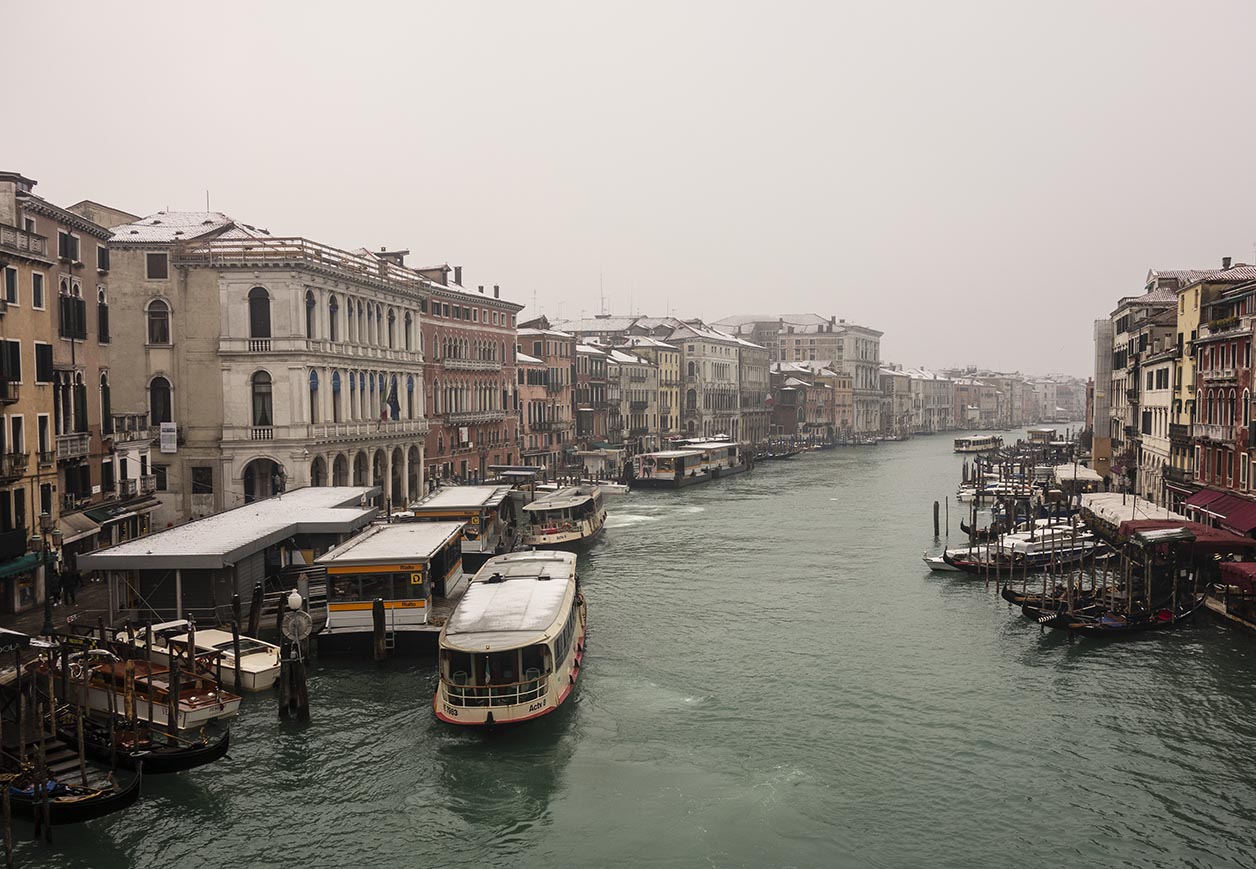 |
| Grand Canal from the Rialto Bridge |
Friday, December 8, 2023
Mongolia | Ulaanbaatar | Soyolma
 |
| New painting by Mongolian artist Soyolma (click on photos for enlargements). |
 |
| Soyolma in her studio. The painting behind her is now in my Zaisan Tolgoi Galleria. |
 |
| Soyolma’s painting in my Galleria |
 |
Soyolma is also a thangka painter. Here is a White Tara thangka she painted for me. Now in my Galleria. |
Wednesday, November 1, 2023
Mongolia | Ulaanbaatar | Soyolma and Davaanyam
Shook the dust off my mukluks and wandered into town for a showing of new works by Mongolian artist Soyolma and her husband Davaanyam. I already have a number of Soyolma’s paintings on display in the Galleria of my Hovel in Zaisan Tolgoi.

Soyolma and one of her new works (click on photos for enlargements)

Detail of new work by Soyolma

Work by Soyolma

Detail of work by Soyolma

Work by Soyolma

Work by Soyolma

Green Tara by Soyolma

Soyolma and Green Tara

Work by Soyolma

Detail of work by Soyolma

Work by Soyolma

Large Triptych by Soyolma. This work was earlier displayed in New York City.

Detail of Large Triptych

Text explaining the Triptych
Tuesday, September 26, 2023

Saturday, September 2, 2023

Turkey | Mardin | Deyrulzafaran Monastery
Deyrulzafaran Monastery is located about three and half miles from downtown Mardin. Every travel agent in town offers a stop at the monastery on one their tours of the local sites, but there does not seem to be any public transportation. A taxi costs 25 lira ($11.77), which seemed rather exorbitant. I tried to bargain the price down to 20 lira with several different taxi drivers but to no avail. The last one got a bit huffy and unleashed a barrage of Turkish at me that didn’t seem all that friendly. So I decided to walk. If I can’t walk three and a half miles in an hour it is time to hang up my walking cane. At ten in the morning it was still fairly cool and the walk out of town went quickly. I soon arrived at the turnoff to the monastery at the village of Eskikale. From here it about a mile to the monastery through sparsely vegetated hills inhabited by flocks of sheep and the occasional horse and frolicking colt.
Outside of the monastery were half a dozen big tour buses, dozen or more minivans with tour groups, and a sprinkling of private vehicles. Just outside of the monastery grounds is a new visitors center with an extensive gift shop and a cafe with abundant patio seating. After quaffing down two liters of water I bought a six lira ticket and entered the monastery.
Deyrulzafaran is one of the oldest monasteries in the world. It was founded in 439 on the site of a former sun-worshippers’ temple, as was the Mor Behnam and Mort Sara Church. Unfortunately only the main courtyard and several rooms fronting on it, including a small chapel, are open to the public.

Deyrulzafaran Monastery (click on photos for enlargements)

Deyrulzafaran Monastery

Main entrance to Deyrulzafaran Monastery

Gateway leading to the inner courtyard

The inner courtyard

The inner courtyard

Walkway fronting on the courtyard

Walkway fronting on the courtyard

Dining Hall in the monastery

Chapel in the monastery

View of the plains of Mesopotamia from the monastery
It was quite a bit warmer by the time I started walking back to Mardin. I did not have a hat, and the sun was uncomfortably hot on my head, freshly shaven just this morning. I was just about out of steam by the time I reached the main road back to Mardin. Maybe it was time for me to hang up my walking cane. Then a car stopped. Inside were three downright gorgeous women who looked to be in their twenties or early thirties. The driver asked me in a sexy French accent if I needed a ride. For a moment I thought I might have stepped into a scene in some risqué French movie. Did these women drive around country roads picking up men and ravishing them? Were these women about to ravish me? No, as it turned out. The driver explained that she and her friends were from France but working in Istanbul. They had flown to Mardin the evening before, rented a car, and were taking in the sights. They planned to fly back to Istanbul tonight. They were now on their way to Midyat. We drove to the edge of town and they dropped me off at the cutoff to Midyat. Back in the Mardin town square I saw one of the taxi drivers who had turned down my offer of 20 lira earlier. “Manastir—yirmi besh! (monastery—twenty-five lira),” he offered, I held out my ticket stub to the monastery and made walking motions with my fingers. He snorted, clearly not believing I had walked to the monastery and was back in time for lunch.
Subscribe to:
Comments (Atom)