 |
| New Painting by Mongolian artist Soyolma |
Monday, January 5, 2026


Saturday, January 3, 2026
Mongolia | Zaisan Tolgoi | Full Wolf Moon | Perihelion

The Full Moon occurs here at 6:02 PM. This is the Wolf Full Moon, so named because traditionally this is thought to be the time when wolves howl at the moon from hunger. This may not be totally accurate, however: “Howling and other wolf vocalizations are heard in the wintertime to locate pack members, reinforce social bonds, define territory, and coordinate hunting,” not necessarily because they are hungry.
Other names for the January Full Moon:
Another fitting name for this Full Moon is the Center Moon. Used by the Assiniboine people of the Northern Great Plains, it refers to the idea that this Moon roughly marks the middle of the cold season. Other traditional names for the January Moon emphasize the harsh coldness of the season: Cold Moon (Cree), Frost Exploding Moon (Cree), Freeze Up Moon (Algonquin), and Severe Moon (Dakota). Hard Moon (Dakota) highlights the phenomenon of the fallen snow developing a hard crust.

There will be thirteen Full Moons in 2026, instead of the usual twelve, with two Full Moons in the month of May (May 2 and May 31). This is possible since the lunar month is only 29.5 days long and two can fit into a 30 or 31 day month. The Wolf Full Moon is also one of the three Super Moons that occur in 2026. The two others will occur in November 24 and December 23. Mark your calendars. Super Moons occur when the moon’s orbit brings it closer to Earth than usual. Super Moons can appear up to 14% larger and 30% brighter than the faintest moon of the year, according to NASA.

Today the moon will be a mere 224,403 miles from Earth. The apogee, the farthest the moon gets from Earth, can be up to 252,088 miles, with an average distance between the Earth and the Moon of 238,855 miles. So this Full Moon will be 14,452 miles closer to Earth than the average distance.
By coincidence January 3 this year is also the Perihelion, the day of the year when the Sun is closest to the Earth. This phenomenon has no connection to the Full Moon and the two coincide only rarely. Today the Sun is 91.4 million miles from Earth. Aphelion, when the Sun is the farthest from Earth, occurs in early July, when the Sun is 94.5 million miles from Earth. It may seem odd the Sun is closest to Earth in wintertime and the farthest from Earth in summertime. The distance of the Sun from Earth actually has little or no effect on the seasons, which are determined primarily by the 23.4° tilt of Earth's axis relative to its orbital plane.
The dates of Perihelion and Aphelion are not fixed; they gradually progress through the calendar over centuries due to orbital precession and perturbations from other planets—cycles known as Milankovitch cycles. On a timescale of 22,000 to 26,000 years, perihelion and aphelion complete one full cycle through all seasons. The latest January perihelion will occur in 2089, and the latest July aphelion in 2060; by the year 3800, perihelion is projected to occur solely in February rather than January. Mark your calendars.
As if the Full Moon and the Perihelion are not enough, the Quadrantids Meteor Shower peaks in January 3-4, and Jupiter is the biggest and brightest it will be this whole year. A refulgent Full Moon and gorgeous Jupiter are blazing in the sky west of Zaisan Tolgoi as I write this. It’s an exciting time to be alive!
Tuesday, December 30, 2025
Mongolia | Zaisan Tolgoi | Second Nine-Nine | Khorz Arkhi Khöldönö
I mentioned earlier that the First of the Nine-Nines—the Nine-Nines being nine periods of nine days each, each period characterized by a certain type of winter weather—started on the day of the Winter Solstice, which occurred here in Mongolia on December 21. The second of the Nine-Nines begins today, December 30. Known as Khorz Arkhi Khöldönö, this is the time when twice-distilled homemade Mongolian arkhi (vodka) freezes. As you will recall, the first of the Nine-Nines was the time when regular, or once distilled, arkhi freezes. As this indicates, the second period should be colder than the first, since twice-distilled arkhi obviously has a much higher alcohol content. This morning at 2:00 it was —28°F. This may be cold enough to freeze twice-distilled arkhi. The forecast for the night of December 30-31, however, calls for a relatively balmy —11ºF, probably not cold enough to freeze twice-distilled arkhi. The third Nine-Nine begins on January 9.
Sunday, December 21, 2025
Mongolia | Zaisan Tolgoi | Winter Solstice | First of the Nine-Nines
The Winter Solstice, the astronomical beginning of Winter, occurs here in Zaisan Tolgoi at 11:03 pm, December 21. The day before, December 20, the sun rose at 8:38:13 am and set at 5:01:21 pm for 8 hours, 23 minutes, and 7 seconds of daylight. On the 21st the sun rose at 8:38:48 am and set at 5:01:48 pm for 8 hours, 22 minutes, and 59 seconds of daylight. Thus the day of the 21st was eight seconds shorter than the 20th. Normally the day of the Solstice is the shortest day of the year, but this year, because the Solstice occurs so close to midnight, the shortest day of the year is actually the 22nd, when the sun rises 8:39:20 am and sets at 5:02:17 pm for 8 hours, 22 minutes, and 57 seconds of daylight, making it 2 seconds shorter than December 21. On the 23th the day is already two seconds longer—the same as on the 21st—so we are progressing toward the Spring Equinox, which will occur in Zaisan Tolgoi on March 20, 2026, at 10:46 pm. Thus Winter will last 88 days, 23 hours, and 42 minutes.
In Mongolia the Winter Solstice also marks the beginning of the so-called Nine-Nines: nine periods of nine days each, each period marked by some description of winter weather. According to One Source the tradition started in China but became popular in Mongolia during the Yuan Dynasty, founded by Chingis Khan’s grandson, Khubilai Khan:
The history of “counting the nine” can be traced back as early as the Northern and Southern dynasties (420-589). However, it wasn’t until the Yuan dynasty (1271-1368) that the “Nine Times Nine to Dispel the Cold” countdown calendar emerged.
The first of the nine nine-day periods is Nermel Arkhi Khöldönö, the time when once-distilled homemade Mongolian arkhi (vodka) freezes. The forecast for tonight calls for a low of –14ºF, cold enough, I think, to freeze once-distilled Mongolian moonshine, which is maybe half as strong as store-bought vodka. The Second Nine-Day Period starts on December 30. Stayed tuned for updates.
Saturday, December 13, 2025
Mongolia | Baron von Ungern-Sternberg
Interesting story about a Relative Of Baron Von Ungern-Sternberg (the story says she was a descendant of the Baron; he had no children so the woman in question is actually a relative). I wrote at length about the Bloody Baron in False Lama of Mongolia and also in Wanders in the Khentii Mountains of Mongolia: The Source of the Amur River and the Birthplace of the Mongols.
 |
| The world-class psychopath and megalomaniac Baron in his early years |
Quote by the Bloody Baron:
Depravity of revolution! . . . Has anyone ever thought of it besides the French philosopher, Bergson, and the most learned Tashi [Dalai] Lama in Tibet? In the Buddhistic and ancient Christian books we read stern predictions about the time when the war between the good and evil spirits must begin. Then there must come the unknown ‘Curse’ which will conquer the world, blot out culture, kill morality and destroy all the people. Its weapon is revolution. During every revolution the previously experienced intellect-creator will be replaced by the new rough force of the destroyer. He will place and hold in the first rank the lower instincts and desires. Man will be farther removed from the divine and the spiritual. The Great War proved that humanity must progress upward toward higher ideals; but then appeared that Curse which was seen and felt by Christ, the Apostle John, Buddha, the first Christian martyrs, Dante, Leonardo da Vinci, Goethe and Dostoyevsky. It appeared, turned back the wheel of progress and blocked our road to the Divinity. Revolution is an infectious disease and Europe making the treaty with Moscow deceived itself and the other parts of the world. The Great Spirit put at the threshold of our lives Karma, who knows neither anger nor pardon. He will reckon the account, whose total will be famine, destruction, the death of culture, of glory, of honor and of spirit, the death of states and the death of peoples. I see already this horror, this dark, mad destruction of humanity.
 |
Relative of the Bloody Baron: “All these people [are] telling me I should reclaim the throne to Mongolia but I’m literally just a girl who drinks matcha.” She’s also a fox!  |
Friday, November 21, 2025
Mongolia | Chingis Khan Day | Beginning of Winter
Yesterday was the New Moon of November so today is the first day of Winter, at least according to the Lunar Calendar as observed in Mongolia (according to the astronomical definition Winter begins on the day of the Winter Solstice, this year on December 21). On this day the birthday of Chingis Khan (Genghis Khan) is also celebrated. Although it is now generally accepted that he was born in 1162 the day of his birth is unknown, so it is now celebrated on the first day of Winter, an official holiday in Mongolia.
Statue of Chingis Khan near Ulaanbaatar:


Sunday, November 16, 2025
Earth | Lunar Standstill
As most lunaphiles are aware, a Lunar Standstill is occurring throughout 2025, reaching its peak in early November 2025. Specifically, the northern major lunar standstill moonrise is noted on November 7, 2025. This major lunar standstill event is part of the 18.6-year lunar nodal cycle, when the Moon reaches its most extreme northern and southern rising and setting points along the horizon. This event can be observed over a period spanning roughly two years, covering 2024 through 2026, with the peak of maximum standstill near March 2025 and significant standstill points continuing into late 2025.
Human beings noted the phenomenon of Lunar Standstills at least 10,000 years ago and built stone monuments to measure and record these events. Stonehenge is just one of these monuments, as was the Ziggurat at Ur in Mesopotamia (now in Iraq).
I stayed up all night on November 7 to witness this day of the Standstill, which was just two days after the Full Moon. It was a perfectly clear night and the woods was well-lit with moonlight. My only companion was a Barred Owl who serenaded me all night with its distinctive “Who cooks for all?” call.
For the whole lowdown on lunar standstills and much else see the entertaining and informative Our Moon: How Earth's Celestial Companion Transformed the Planet, Guided Evolution, and Made Us Who We Are.
USA | Allegheny Mountains | Deer Season #2
Archery Season for deer is still in full swing. Now a bowhunter has brought me some steaks made from the backstrap of the deer, which many Venison Cognoscenti consider the best cut.
 |
| Venison steaks made from the backstrap of the deer |
 |
| Venison steaks |
 |
My.olive oil had frozen solid so I had to heat it up in a pan of boiling water before I could use it. |
 |
| I fried the steaks in olive oil with onions, black peppercorns, and soy sauce. |
 |
| Now there’s a dish to set before a king!!! |
Had our first snow fall of the year.
 |
| My current domicile |
Temperatures dropped to 16ºF.
 |
| Butter tea was certainly welcome on these chilly mornings. I could close my eyes and imagine I was in Tibet! I am using local Amish butter, which is bright yellow or even orange, an indication of high Beta-Carotene levels, unlike store-bought butter, which nowadays is often pale yellow or even white. The color is usually an indication of Grass-Fed Cows, as opposed to grain-fed cows. Beta-Carotene is good for your health—carrots get their color from beta-carotene—and butter with a high level of beta-carotene usually has a higher fat content, fat being the whole point of drinking butter tea. Beware of commercial butter sellers who are now adding yellow or orange Food Dyes to their butter to make you think it has high levels of beta-carotene. |
 Uyanga enjoying a bowl of butter tea  |
| My carpet collection has come in handy. I bought this handmade silk carpet in Uzbekistan, but it was probably Made in Iran or perhaps Turkmenistan. The big white oak in the photo has shed a prodigious amount of acorns. The neighborhood squirrels are as happy as, well, squirrels with a prodigious amount of acorns. |
Saturday, November 15, 2025
U.S.A | Maryland | Pennsylvania | New Book
 |
Thursday, October 30, 2025
USA | Allegheny Mountains | Deer Season
Bowhunting season for deer is now open in the Allegheny Mountains of Pennsylvania. A bowhunter shot a deer near where I am doing a retreat and for some inexplicable reason he did not want the heart or liver, so I claimed it.
 |
| Heart and liver. The liver was huge. It must have weighed seven or eight pounds. |

 |
| Liver steaks |
 |
| I fried the heart and liver in olive oil with onions and black peppercorns. |
 |
| Now that’s some might fine eatin’! |
Wednesday, October 15, 2025
Mongolia | Zanabazar | First Bogd Gegeen of Mongolia

Zanabazar (1635–1723) was, according to most reckonings, the sixteenth incarnation of Javsandamba. The first incarnation is believed to have appeared around the time of the Buddha. As a small boy he was recognized as the spiritual leader of Mongolia and awarded the title of Bogd Gegeen. He would go on to play a role in the religious and political life of Mongolia analogous to that of the Dalai Lamas of Tibet. Zanabazar built temples and established monasteries, including one at what is now the site of Ulaanbaatar, the capital of Mongolia, and was a polymath who invented new scripts for writing the Mongolian language, designed new clothes for monks, studied the medical properties of hot springs, and much else. He is most famous for his bronze statues which are now the centerpieces of three museums in Ulaanbaatar. “During his lifetime, he was the greatest Buddhist sculptor in Asia,” opines art historian K. Youso about Zanabazar.” Indeed, he is often called the Michelangelo of Mongolia. Zanabazar was the first of Mongolia’s nine Bogd Gegeens. The Ninth Bogd Gegeen transmigrated on March 1, 2012. During a visit to Mongolia on November 23, 2016, the Fourteenth Dalai Lama announced that the Tenth Bogd Gegeen had been born and that attempts were being made to identify him. Update: The Tenth has now been named. See Tenth Incarnation.
See The Life of Zanabazar
Friday, October 10, 2025
USA | Allegheny Mountains | October Full Moon
Normally the September Full Moon is known as the Harvest Moon, a time when traditionally farmers harvest their crops. The Harvest Moon is defined, however, as the full moon closest to the Autumn Equinox. The Full Moon of October 6 occurs 14.395 days after the Equinox, making it fourteen hours and thirty-nine minutes closer to the Equinox than the September Full Moon. Thus the October Full Moon is, technically, the Harvest Moon. This anomaly occurs about once every five years or so, or eighteen times between 1970 and 2050. So if the October Full Moon is the Harvest Moon then what is the September Full Moon, usually the Harvest Moon? Many sources, including the Old Farmer's Almanac, a favorite of hoi polloi, are going with the Corn Moon, when corn is harvested (although not in the area where I am now) for September and the Harvest Moon for October. Not everyone is buying into the Harvest Moon in October business, however. The influential site astronomy.com is sticking with the Hunters Moon for October. The popular site timeanddate.com is going with both, calling the October Full Moon the Harvest/Hunters Moon.
So what then is the November Full Moon? The Old Farmer's Almanac (don’t confuse it with the Farmer's Almanac) is going with the Beaver Moon for November, as is astronomy.com.
I am sticking with the Hunters Moon for October, the Old Farmer's Almanac and others be damned. This is the time of the year when as a young boy I always hunted small game and I always associate the October Moon with hunting. The Hunters Moon of October also always heralded the finest weather of the year (in my opinion); cool, crisp days and often below freezing temperatures at night. Of course with our changing climate this is often no longer the case. On October 6 this year the high at my current location was 77ºF with a low of 56ºF, temperatures not traditionally associated with October.
Whatever it is called, the October Full Moon was a doozy. The perigee, when the moon comes closest to the earth in 2025, occurred just two days after the Full Moon, on October 8 at 8:38 a.m. At this time the moon was a mere 223,581 miles from Earth. The apogee, the farthest the moon gets from earth, can be up to 252,088 miles, with an average distance between the Earth and the Moon of 238,855 miles. This perigee will result in the largest and brightest Super Moon of the year, about 7–8% larger in diameter and 15–16% brighter than the average full moon.
 |
| The Full Moon of October just peeked above the Alleghenies at 6:42 pm and by 6:45was about halfway up. |
 |
| The October Full Moon cleared the Alleghenies at 6:48 pm |
 |
| October Full Moon over the Alleghenies |
 |
| October Full Moon over the Alleghenies |
 |
| October Full Moon over the Alleghenies |
 |
| October Full Moon over the Alleghenies |
 |
| I prepared some Moon Water by leaving fresh spring water out all night to absorb moonlight. The next morning I used the Moon Water to make Goldenrod tisane. I had collected the goldenrod leaves ten days earlier. I am still buzzing off this stuff! |
Monday, August 25, 2025
Mongolia | False Lama of Mongolia: The Life and Death of Dambijantsan
Who was Dambijantsan?
A Buddhist monk; a freedom fighter for Mongolian independence; the descendant of Amursanaa (1723–1757), the Western Mongol who led the last great uprising against the Qing Dynasty of China; the incarnation of Mahakala, the Buddhist god of war; bandit, torturer, murderer, or evil incarnate? During his lifetime no one was sure who he really was, and even today the controversy about his life continues.
Born in what is now the Republic of Kalmykia, part of the Russian Federation, Dambijantsen traveled throughout Tibet, India, and China before arriving in Mongolia in 1890 where he tossed gold coins to bystanders and announced to one and all that he had come to free Mongolia from the yoke of the Qing Dynasty of China. After disappearing almost twenty years he returned to lead the attack on Khovd City, the last Chinese outpost in Mongolia. Honored by the Eighth Bogd Gegeen, the theocratic leader of Mongolia, for his efforts in achieving Mongolian independence, he went on to establish his own mini-state in western Mongolia, which he hoped to use as a base for establishing a Mongol-led Buddhist khanate in Inner Asia. His dictatorial nature and unbridled sadism soon came to the fore and he was finally arrested and imprisoned in Russia. After the Russian Revolution he returned to Mongolia, gathered new followers around him, and established a stronghold at the nexus of old caravan routes in Gansu Province, China. He robbed caravans, grew opium, and once again dreamed of creating a new Mongolian khanate in Inner Asia. Finally the new Bolshevik government in Mongolia, fearful of his rising power, issued orders for his assassination. Dambijantsan transmigrated in 1922, but in Mongolia legends persist to this day that his spirit still rides on the winds of the Gobi and continues to haunt his former lairs.
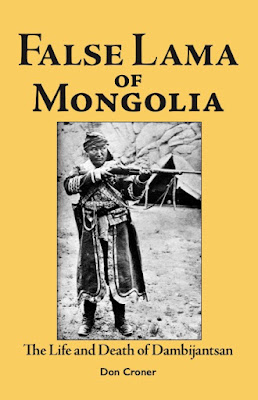
For more on Dambijantsan see False Lama of Mongolia: The Life and Death of Dambijantsan.
Friday, August 22, 2025
United States | Maryland | Great Allegheny Passage | Cumberland | Mount Savage | Frostburg
In Cumberland, Maryland, the Spring, or Vernal, Equinox occurred at 11:06 p.m. on March 19, according to the Gregorian calendar imposed on the Occidental world by Pope Gregory XIII in 1582. The Equinox marks the astrological astronomical beginning of the spring season in the Northern Hemisphere. It’s often said that the Spring Equinox is when day and night are of equal length. Actually, due to an astronomical quirk, the date when day and night are equal, known as the Equilux, is usually a few days before the Equinox. This year March 15 has eleven hours, fifty-nine minutes, and fifty-five seconds of daylight. The next day has twelve hours, two minutes, and thirty-one seconds of daylight, so the pendulum has already swung toward longer days. The day of the Equinox has twelve hours, ten minutes, and twenty-four seconds of daylight. The next day has twelve hours, thirteen minutes, and zero seconds, making it two minutes and thirty-six seconds longer than the day before. The procession is on to the Summer Solstice, the longest day of the year, on June 20. I have decided that between the Spring Equinox and the Summer Solstice I will wander on the Great Allegheny Passage, a bike and hiking trail built on the roadbeds of now-abandoned railroads that extends 150 miles from Cumberland to Pittsburgh, Pennsylvania. Another trail, the C&O Canal Towpath, runs 184.5 from Cumberland to Washington, D.C, making it possible, in season, to ride a bike—or hike, if you are so inclined—334.5 miles from Pittsburgh to Washington. No motorized vehicles (except for electric bikes) are allowed on the entire path. Before proceeding on the GAP I will first explore the city of Cumberland . . . Continued.

Subscribe to:
Comments (Atom)